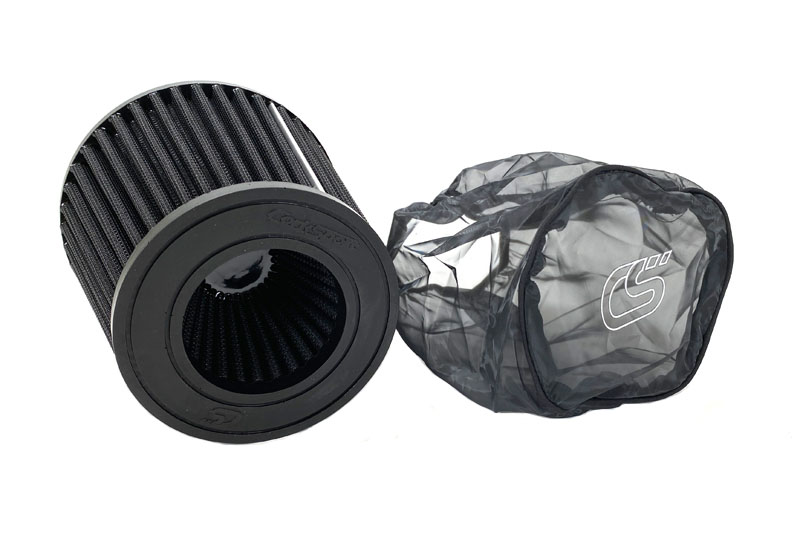
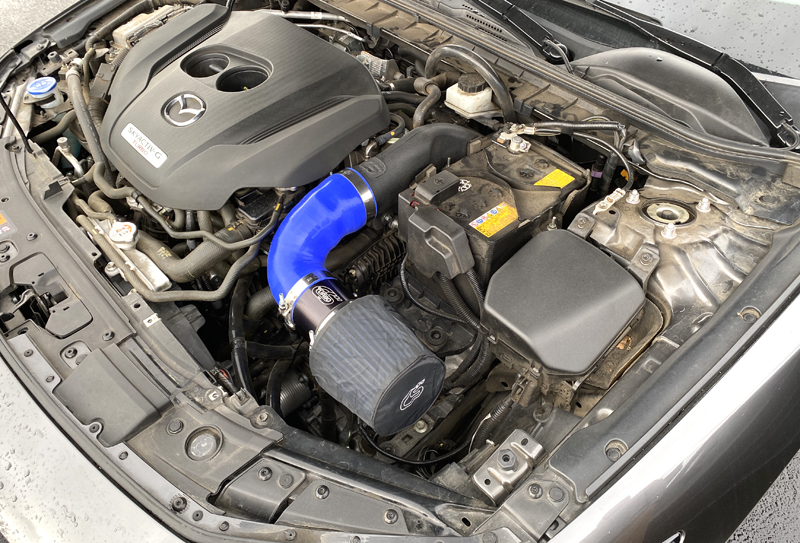
Based on popular demand, we have developed a filter sock that will help fight dust and water spray from entering the engine. The CorkSport Mazda Air Filter Cover mod can help maintain the flow efficiency of your main filter and extend its service life.
Quality Materials
The Air Filter Cover is made from a polyamide fabric mesh and allows for good airflow while adding a layer of protection for your air filter and engine. The cover protects against dust, large debris, and light water spray from entering the filter media.
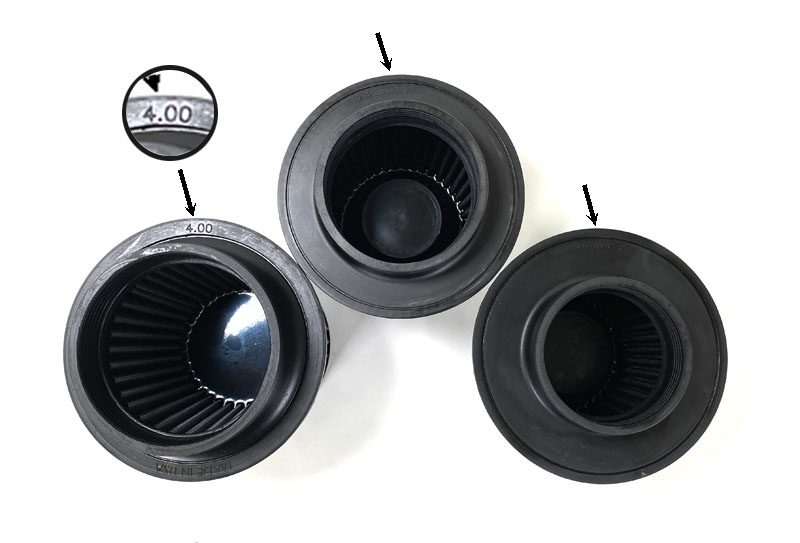
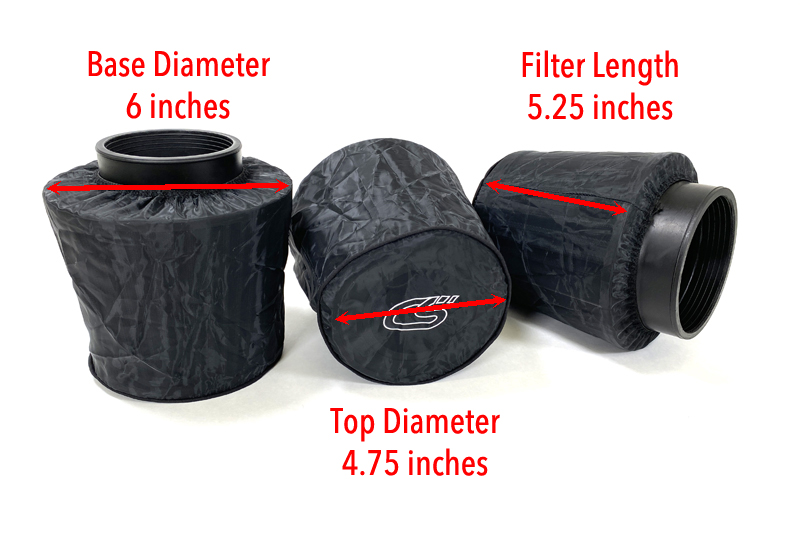
The small air filter sock works on 3.0, 3.5, & 4.0 marked air filters only
The large air filter sock works on the 4.5 marked air filter only
You can check your CorkSport air filter here:
If you don’t have a CorkSport specific intake, there is still a good chance your Mazda can enjoy the benefits of our air filter sock. Follow the diagram below to see if your air filter size matches:
Air Filter Sizes 3.0″, 3.5″, 4.0″
With fall upon us and winter just around the corner, now is the best time to add an extra layer of protection to your Mazda! Thanks for checking out the new air filter sock cover for your Mazda intake system.
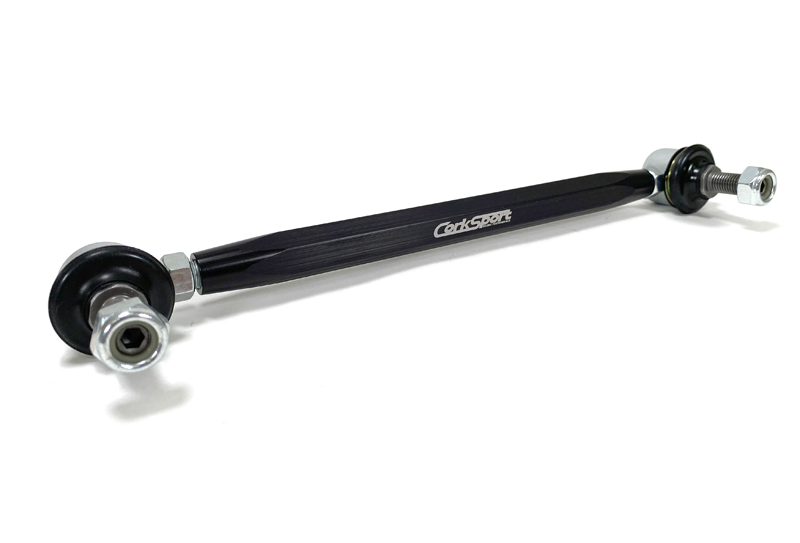
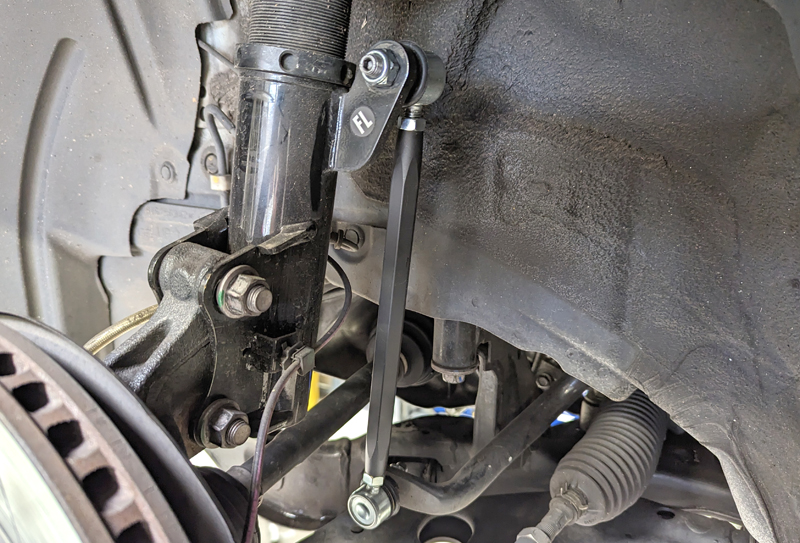
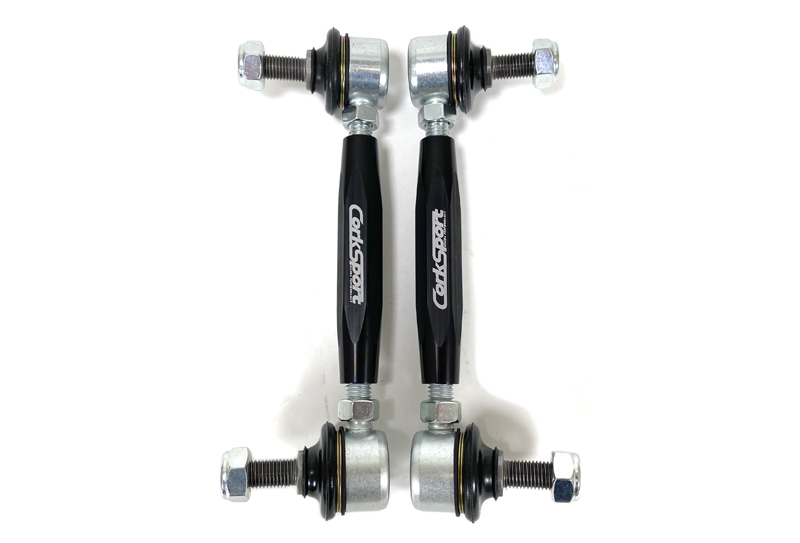
Do you need to replace your swaybar end links and want an upgrade at the same time or are looking to adjust your sway bar to better match the factory position on your lowered car? That’s where the Performance Adjustable End Links come in and they are now available for the following models: 2019+ Mazda 3, 2014-2018 Mazda 3, 2021+ CX-30, 2022+ CX-50, 2014+ Mazda 6, 2013+ CX-5, 2016+ CX-9, and 2006-2007 Mazdaspeed 6. Depending on your specific application, both front and rear end links are available. The new CS Adjustable End Links build off of the wildly popular kit available for the Mazdaspeed 3 and carry over all the same benefits which are discussed below.
Why You Need End Links
Getting straight to the main advantage of the CS end links is their variable length. The CS end links offer ~18mm or 0.70in of adjustability. This results in an end link that can be up to 9mm longer or 9mm shorter when compared to the stock part.
If your car is lowered, our end links allow you to account for the change in sway bar position that occurs when you lower your car so it can be placed closer to its original position. When the sway bar is not positioned in the OE location it can lead to sway bar preload or binding which can have negative effects on handling. This also means that if you are planning on adding a lift they can help in the same way.
Quality Matters
The construction of the end links also maintains the same high quality as found in the current end links for the MazdaSpeed 3. The center section is CNC machined out of 2011-T3 5/8in hex aluminum to provide a large increase in size over the OE part while being easily adjusted to your specified length with a wrench. After machining, the center section then gets anodized in black to provide a finish that will help protect it from corrosion.
The included ball joints feature a sealed design to reduce the chance of water or other foreign material from gaining access to the joint. This allows the ball joint to provide a longer service life so that it won’t require any additional maintenance compared to the OE end links.
With the long new list of applications, you should have no problem finding a set of CS adjustable end links that will fit your Mazda. Be sure to head over to the product listing for your specific model for more info and pictures. As always, reach out if you have any questions about the end links for your setup.
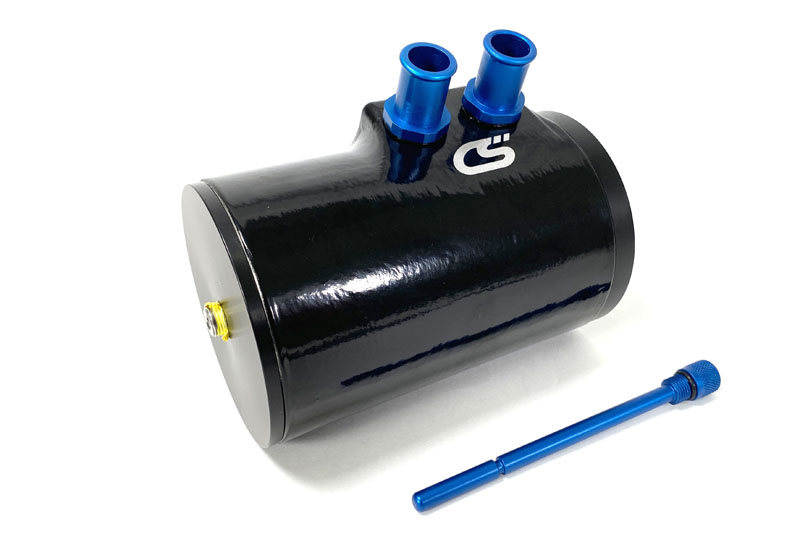
Let’s talk Oil Catch Cans! While not the most exciting performance part for your turbo Mazda 3; when properly applied they can be a keystone to improving the health and longevity of your engine’s life. With that being said, they are worth a discussion in more detail about why an oil catch can (OCC) is needed and what the benefits are. As with any performance modification, there are many different ways to achieve the end goal, but not all are created equal.
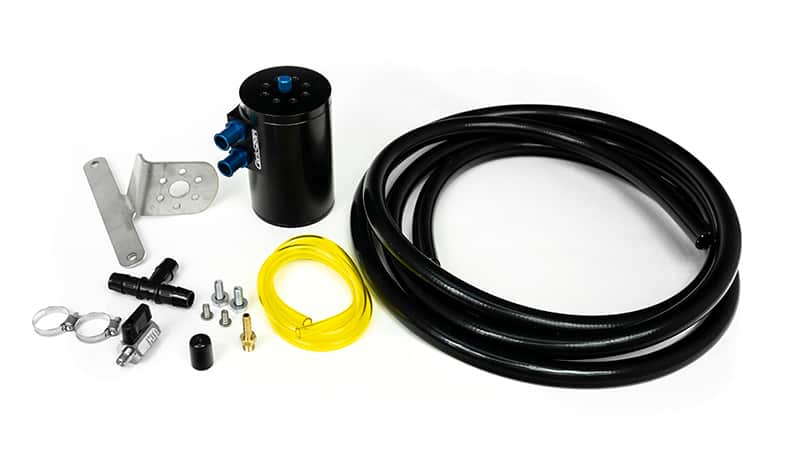
Let’s break down the CorkSport Oil Catch Can system so you can learn and understand why we utilize an OCC the way we do. While we did break this down a bit back in 2019 here, we want to take it a step further now.
Improving the System
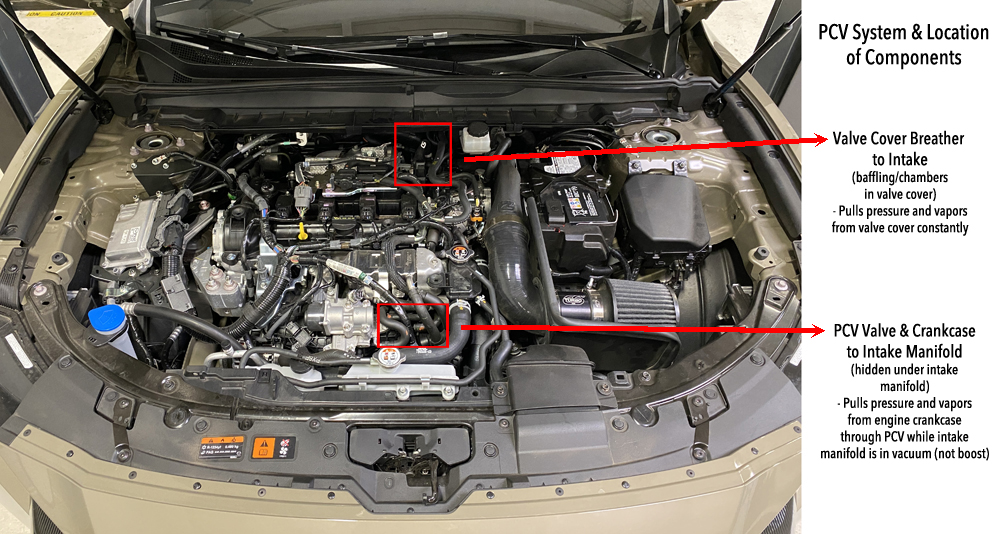
First, let’s provide you with some context. What is the system on the car/engine that the OCC Kit is working to improve? All modern engines utilize a Pressure Control Ventilation (PCV) system to regulate and control the internal pressure of the crankcase. This is not to be confused with the pressure inside the combustion chamber.
As you can see in the image above, there are two major components of the PCV system on the engine. Typically there is a breather vent integrated into the valve cover that will vent/route directly into the intake system. On turbocharged engines this vents upstream of the turbocharger compressor inlet.
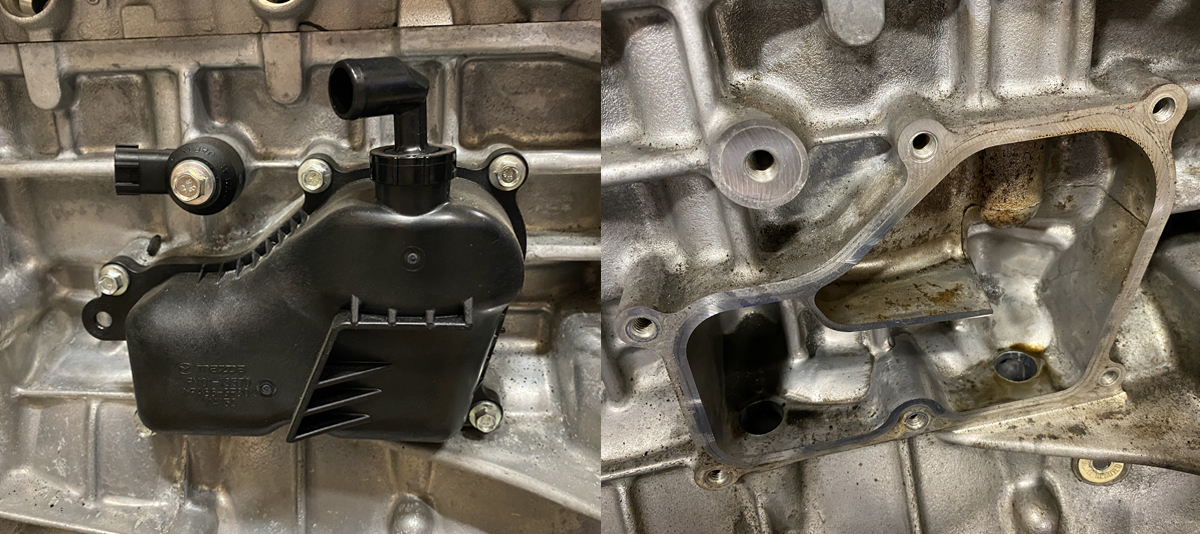
The second part is a “cover” on the front side of the engine block typically hidden under the intake manifold. This cover has built-in baffles/chambers and a PCV valve. The PCV valve is a basic one-way check valve that allows pressure to flow out of the engine crankcase and into the intake manifold directly.
Left Side: Here is an example of a SkyActiv-G 2.5L PCV Cover with the PCV Valve at the top.
Right Side: Here is an example of the baffling on the engine block inside the PCV Cover.
The Goal
So what’s the point/goal of the PCV system? Two main reasons:
Reducing the pressure buildup inside the engine crankcase. This improves the durability/longevity of the engine and improves engine efficiency.
Emissions control. The pressure buildup inside the crankcase comes from the combustion process in the cylinders. The rings on the pistons do not have a perfect seal, thus some combustion gasses and fuel are able to push past the piston rings and into the crankcase. This is called “blow by”. This blow by and fuel getting past the piston rings worsens during cold start and eventually results in dilution of the engine oil due to the excess fuel.
We invite you to check out the Engineering Explained video about this specific topic. He does a great job explaining and showing this exact system and issues with it. https://youtu.be/uVd-ZS5bnyY?t=337
Here you can see the captured fuel and water vapors of a CorkSport OCC installed for ~3000 miles on a 2018 Mazda 6 2.5T. This engine only had 500 miles at the time and had an average commute of 15 miles & 20 minutes of mixed traffic and speeds.
Had there not been an OCC installed, this vapor would have been directly ingested into the intake system at the turbo compressor inlet and the intake manifold. Over enough time, this builds up on the surfaces of the intake system, turbocharger, intercooler system and intake valves…diminishing performance and fuel economy.
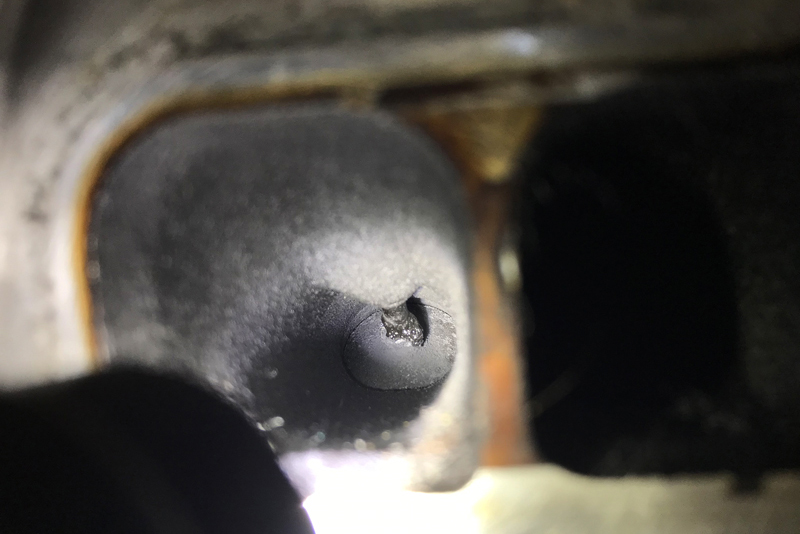
Sadly, while Gasoline Direct Injection (GDI) technology has provided some exceptional improvements in power and fuel economy, there are still negatives to the overall system. Dirty intake valves and fuel dilution are the main concerns.
Here is an example of direct intake valves…
Now let’s talk about what makes the CorkSport OCC System unique vs the current options available.
It’s a complete system, not a half system. Meaning the CorkSport OCC incorporates the valve cover breather AND the PCV cover on the front of the block.
Dual Chamber Design: this separates the incoming vapor from the valve cover and PCV cover to the lower chamber to condense and be drained later. The air then passes through a baffle to the upper chamber and then exits to the intake system.
Constant Vacuum: Due to the design, the CS OCC has a constant vacuum pulling pressure and vapor from the crankcase. This is important to note because with the OEM system, the PCV Cover and valve close while in boost…which is when most blow by is happening. With the CS design, you are pulling more vacuum through the OCC while in boost.
Low Mounting: While this seems trivial it’s important from a physics standpoint. The fuel in the oil turns into vapor once the engine and oil are up to temperature. Then the OCC can draw the vapor out of the engine. Once this happens the vapor will start to condense back into a liquid; most of it will make it to the OCC itself but some will condense in the hose. We want the hose to drain into the OCC, not the engine.
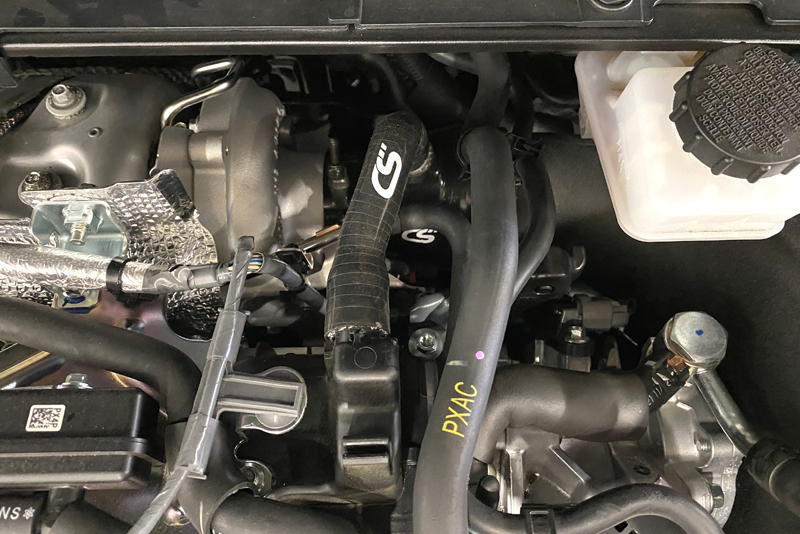
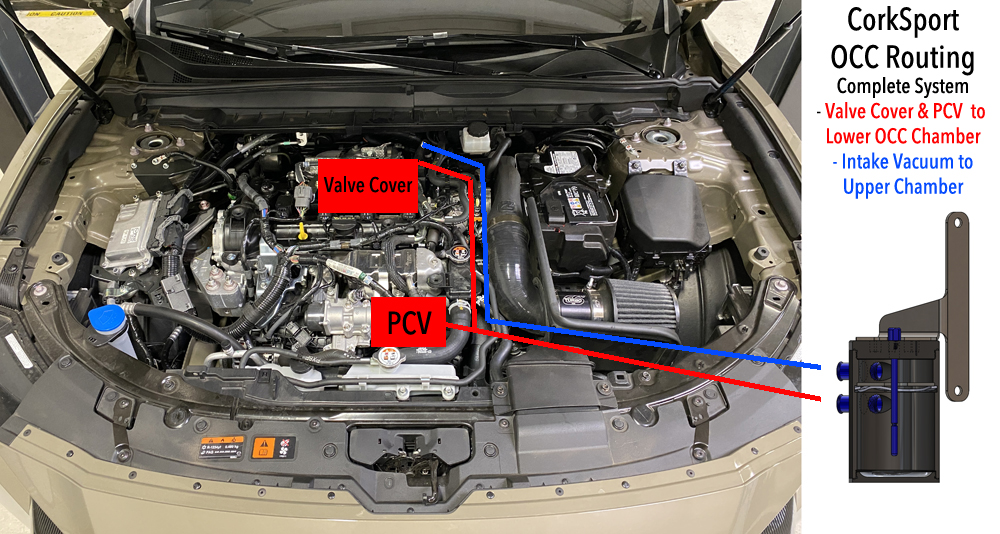
Here you can see the general routing of the CorkSport oil catch can over a CX50 engine bay (routing is the same for all turbo 2.5L SkyG models). The red lines are the routing from the valve cover breather and the PCV. They “T” together and then enter the lower chamber of the OCC. The blue line is the clean air exiting the OCC and being drawn into the intake system just before the turbo compressor inlet.
Let’s wrap this up! GDI Tech is great but has some issues. In factory form, the OEM PCV system works but could be better…enter the CorkSport Oil Catch Can Kit.
By changing the routing and adding a proper tank to catch the oil, fuel, water vapors that collect inside the engine you are effectively helping your engine breathe better. Reducing the amount of particulates and vapor entering the intake system reduces the overall build-up on the intake valves and other various components.
With the optional drain valve system, you can easily service the OCC when you perform you regular oil changes. While not sexy, it is essential and your Mazda will love you for it.
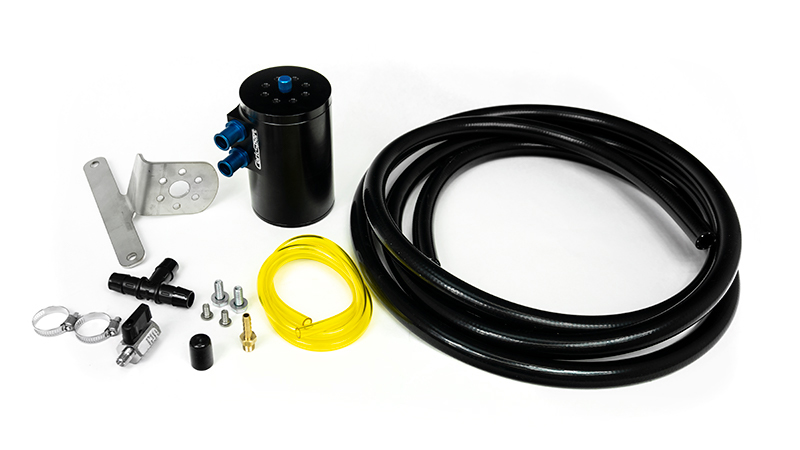
We hope you have enjoyed this tech blog and we hope it has helped you learn more about your beloved Mazda. Check out the Oil Catch Can for more details and to get yours today!
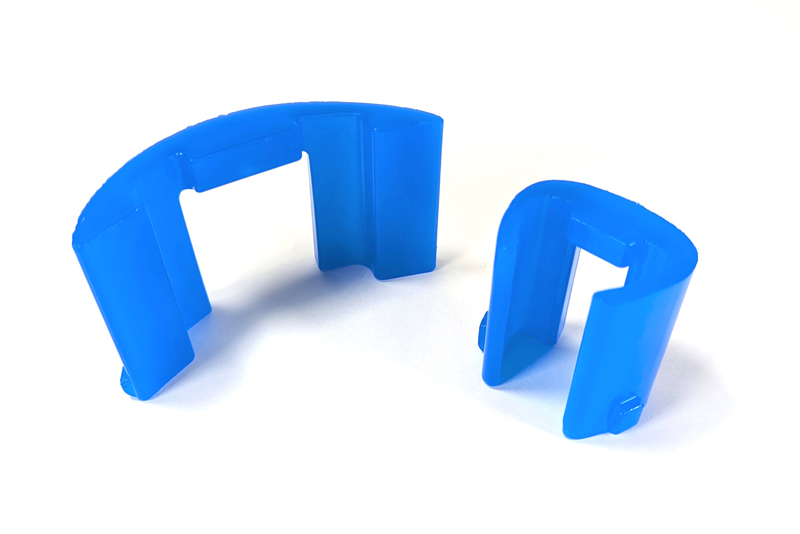
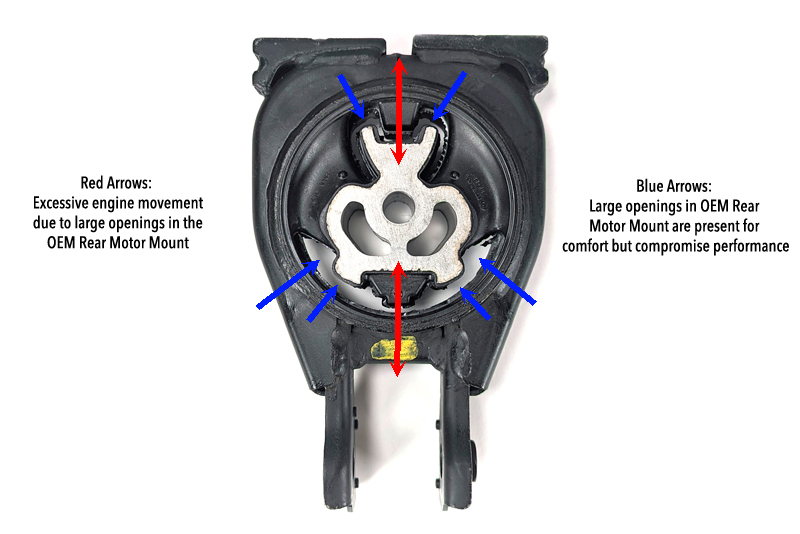
For those looking for a Rear Motor Mount upgrade for your 4th GEN Mazda 3 or CX-30 but don’t want to add too much additional NVH, we are excited to release the CS RMM Inserts. The CS Inserts utilize the OEM mount and offer performance quality between the stock and CS Rear Motor Mount. This means you will get less NVH from the upgrade when compared to the CS RMM, which will be great when driving around town. While not being as aggressive as the full replacement CS RMM, you will see a nice improvement in feedback and responsiveness when pushing it on the back roads or in other situations in which you are utilizing the full potential of your Mazda. If you are interested in this new option, keep on reading for more specifics on how the CS RMM Inserts were designed.
NOTE: NVH (noise, vibration, harshness) is a standard term used in the automotive industry. NVH is a byproduct of changing some OEM components to aftermarket components in the pursuit of focused performance. Examples of components that can increase NVH: are engine mounts, clutch/flywheel, intake, exhaust, suspension, tires/wheels…and many more.
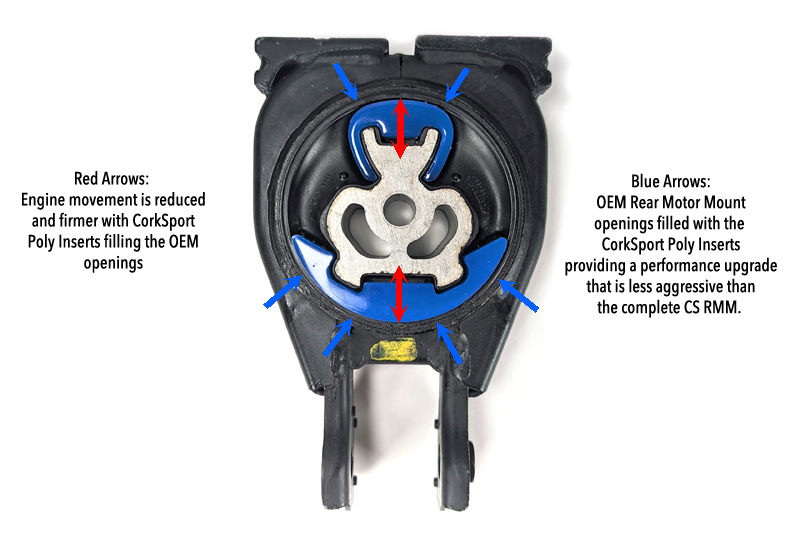
During the design process, we started with the Mazda 3 OEM rear motor mount and worked on modeling inserts that would completely fill the two openings. Once the initial designs of the two inserts were completed we began testing the samples and started with both front and rear inserts installed at the same time. Our initial impressions were quite surprising. We found that this combo resulted in the same if not more NVH than when the full CS Rear Motor Mount was installed.
Since the dual combo didn’t get us to where we wanted, we then tried each insert one at a time. This helped quite a bit and reduced NVH down closer to where we wanted. The issue we encountered when using only one insert was that the gear with worse NVH varied depending on whether we were in drive or reverse. This led us to trim and remove sections of the front and rear inserts to try and get the best of both worlds. By removing the center of the inserts, we were able to find a design that operated in line with our target performance levels. It ended up being a good middle ground between the stock and CS RMM. A comparison of the performance can be seen in the video below showing all three options.
Now onto some other specs of the CS Inserts. The durometer of the polyurethane we selected for the front and rear inserts is 70A. This gives the inserts enough flex to be installed into the mount without too much effort. This all allows for a tight fit so they do not work their way out during operation. Locking tabs were integrated into the inserts to ensure they remained installed in their correct position.
Unleash the potential and growl from your car and take the step forward into more power! A full 80mm Turbo Back exhaust is now possible with CorkSport’s new Catted Turbo Downpipe for the 2021+ 4th Gen Mazda3 Turbo (as well as CX30 & CX50 Turbo Models)!
Our downpipe uses a two-piece design, making installation easy without the need to wrestle with a single large, cumbersome pipe. The Downpipe starts with a high-flowing cast 304 Stainless Steel Bellmouth, then joins the 80mm mandrel-bent piping with a V-band connection for a leak-free seal.
An updated high-flow catalytic converter is utilized in our V2 downpipe. Our V1 downpipe used a Euro 3 300cel catalyst that showed mixed results with check engine lights (CELs). Our new and improved V2 unit uses a Euro 6, 500cel catalyst for the best in emissions control while minimizing those pesky CELs. Euro 6 is (generally speaking) a more strict set of emission parameters than in the USA. We also went for a more dense catalyst (500cel), which, when combined with an upsized 5” diameter, showed no significant power difference from the V1 300cel or even a fully catless prototype unit (catless not available).
The updated catalyst has shown no check engine lights through our testing. We cannot guarantee no CELs as testing all possible climates, driving conditions, local fuels, elevations, and any and all combinations of these is nigh on impossible! However, we are happy to report no CELs through ~10 months and ~14,000 miles of driving!
Do I Need A Tune?
Addressing the other elephant in the room: Tuning. We highly recommend getting a tune after installing the 80mm downpipe as there are very strict airflow limits in the stock tune that severely limit power. This will result in some mild stutters, surging, or “hiccups” at wide-open throttle. This does not do any damage as it is simply a very conservative safety limit for stock components.
With more flow-efficient parts (i.e upgraded intakes , Turbo Inlet Pipe, and exhaust systems), these limits are being reached much easier and the ECU will limit the power output of the engine. The vehicle will be drivable on the stock tune and still give you an aggressive growl out of your 2.5T!
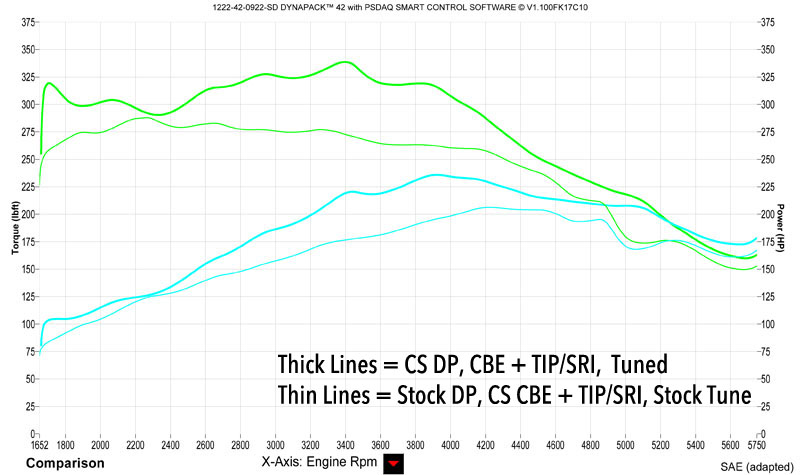
Here you can see the power gains with a fully-bolted Mazda 3 Turbo that is tuned vs stock downpipe and stock tuning.
Dynograph of the Mazda 3 Turbo Downpipe with CorkSport CBE, TIP/SRI – Tuned vs Stock Downpipe + CorkSport CBE, TIP/SRI – Stock tune.
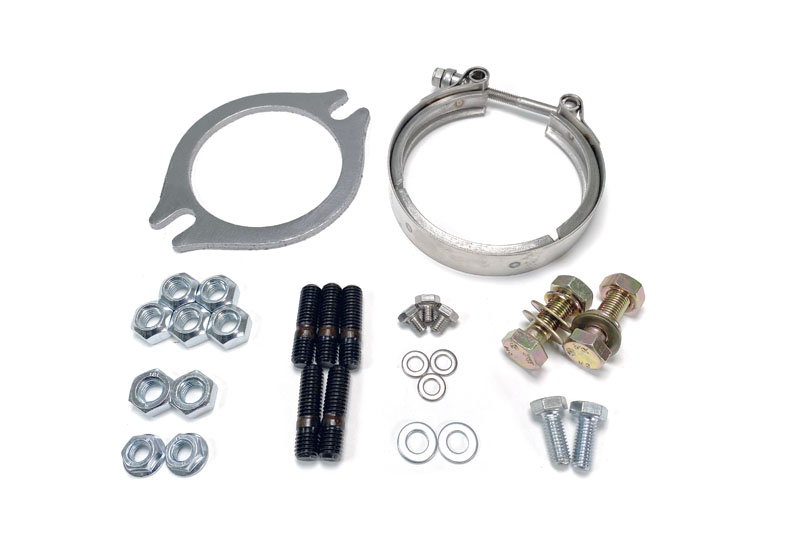
Each Downpipe kit comes with a complete pack of all the hardware and gaskets needed for installation. This includes: