The New CorkSport Steering Wheel for 2007-2009 Mazdaspeed 3

Increase your Mazdaspeed's handling and style with this new leather steering wheel.

Looking to add a little style to the interior of your Genjuan? Or maybe you’re searching for another performance product to give you the edge? What if I told you I could give you both of those with one performance product?

Introducing the new CorkSport Performance Steering Wheel for 2007-2009 Mazdaspeed 3!

Increase your Mazdaspeed's handling and style with this new leather steering wheel.

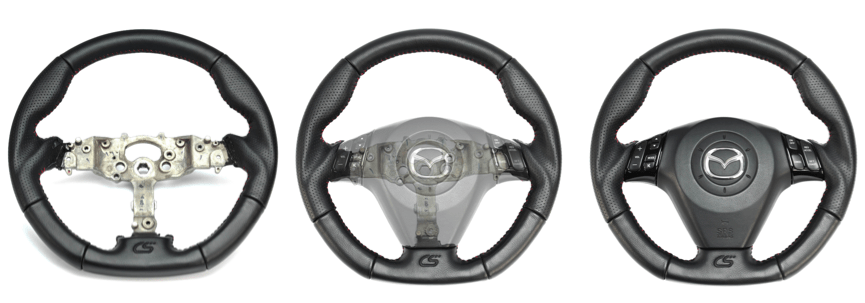
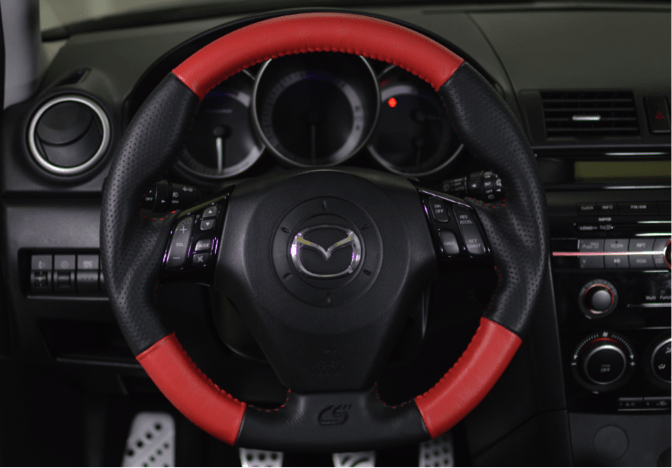
No stitching is required! The CorkSport Performance Steering Wheel was designed to be a direct OEM replacement. It works flawlessly with the OEM steering column, covers, button panels, and airbag for a stress-free 30-minute installation. Check out the images below: On the left shows exactly what you would receive in the package. On the right is a fully assembled steering wheel with all the OEM components.

Installing Mazdaspeed 3 Steering Wheel

Now I have to admit, when this product idea (Big thanks to Brett Ross!) came across my desk, I was a bit skeptical. Iโ€™m not one to spend money on aesthetics on my Mazdaspeed 3. So we got a prototype manufactured, and I installed it in my car to begin the R&D process. Within minutes, I was soldโ€”and not just by how good it looked in my 09โ€™ MS3, but byย how much more connected I felt with the car.

Mazdaspeed 3 Steering Wheel for Better Driving Experience

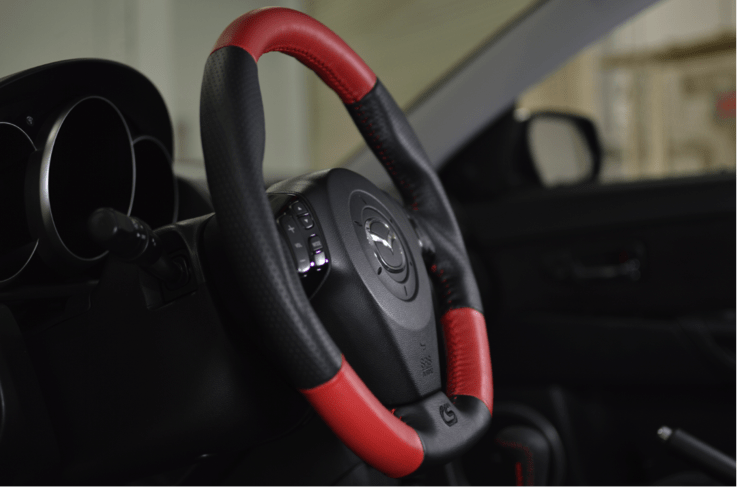
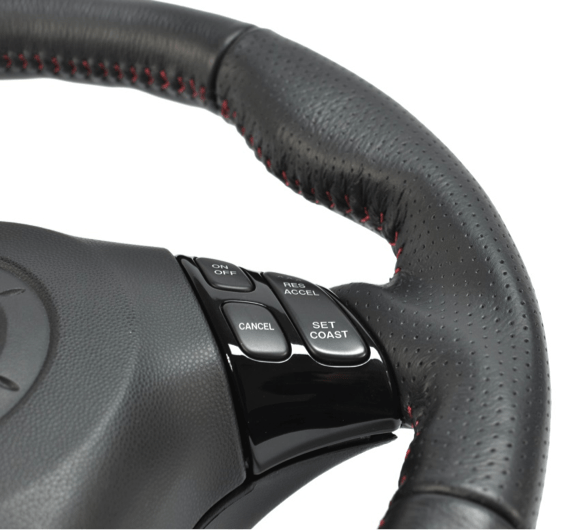
While driving I saw the value in a performance steering wheelโ€”things like the hand-wrapped and stitched leather that has a slight texture and plush feel to it. The perforated leather in the high-use areas is a great addition so your hands wonโ€™t get clammy on spirited drives. The wheel diameter is the same, but the thickness of the wheel has been increased, which is much more comfortable for long drives and canyon carving. The flat bottom gives it a more aggressive feel and actually makes it easier to get in and out of the car since Iโ€™m 6โ€™ 2โ€ tall. All that said, probably the most exciting feature of the CorkSport Performance Steering Wheel are the aggressive thumb grooves. These help you lock your hands in place, giving you more confidence in the twisty roads and while fighting the lovely torque steer.

Why You Need a New Mazdaspeed 3 Steering Wheel

Trust me when I say, you need to try the CorkSport Performance Mazdaspeed 3 Steering Wheel. You will be pleasantly surprised.

-Barett, CS Engineering.

Life in the FSAE Lane: A Year-Long Journey

Have you heard about FSAE? You Havenโ€™t? Well, grab a beer and take a seat. We have quite the journey ahead of us.

The Basics

Formula SAE (Society of Automotive Engineers) is an international collegiate design competition held among colleges and their associated student groups. The project is to design and build an open-wheel race car (within the specified rules) to compete in both dynamic and static events.

The dynamic events include:

  • A 300ft drag race
  • Left/right skid pad
  • Single pass autocross track
  • A closed loop autocross track run for 20 minutes, which is also scored on fuel economy.

The static events include:

  • An engineering design event
  • A cost analysis event
  • A marketing presentation.

The goal of the project is to simulate a new startup company that designs and builds track day cars that are affordable for the average guy. All right. That’s the background. Now, I hope you enjoy my personal FSAEย journey.

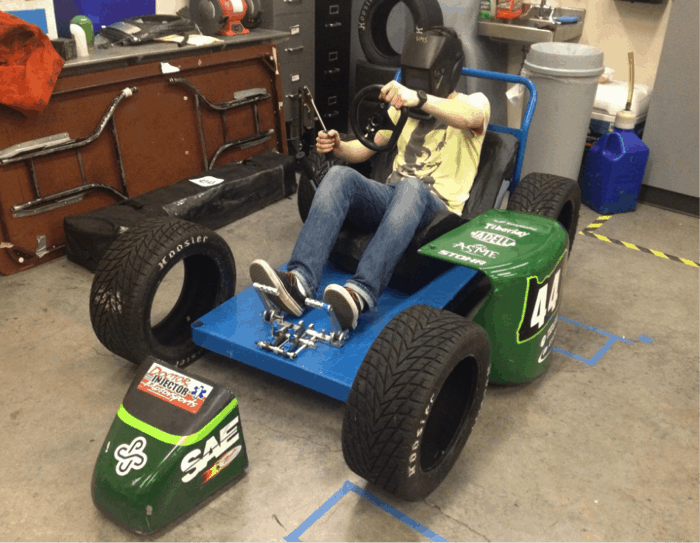
FSAE Sample Race Car Design

First Encounters with FSAE

For me, it all started in September of 2011. I had just transferred to Portland State University (PSU) to begin my upper division classes in Mechanical Engineering. The classes were difficult, and I didnโ€™t know anyone at Portland State. One day,ย I came across the PSU Viking Motorsport Formula SAE student group. I was instantly hooked, getting whatever information I could from the couple of members I met. Before I knew it I was in the student groupโ€™s lab, tinkering with the car and asking way too many questions. I had no idea what I was getting myself into at the time, and I’llย admit: Iโ€™m glad I didnโ€™t because I donโ€™t know if I would have stuck it out any other way.

I attended a second meeting with enthusiasm, which landed me managing the cooling system for the next race car. A mixture of stress and excitement overwhelmed me.

Building an FSAE Race Car

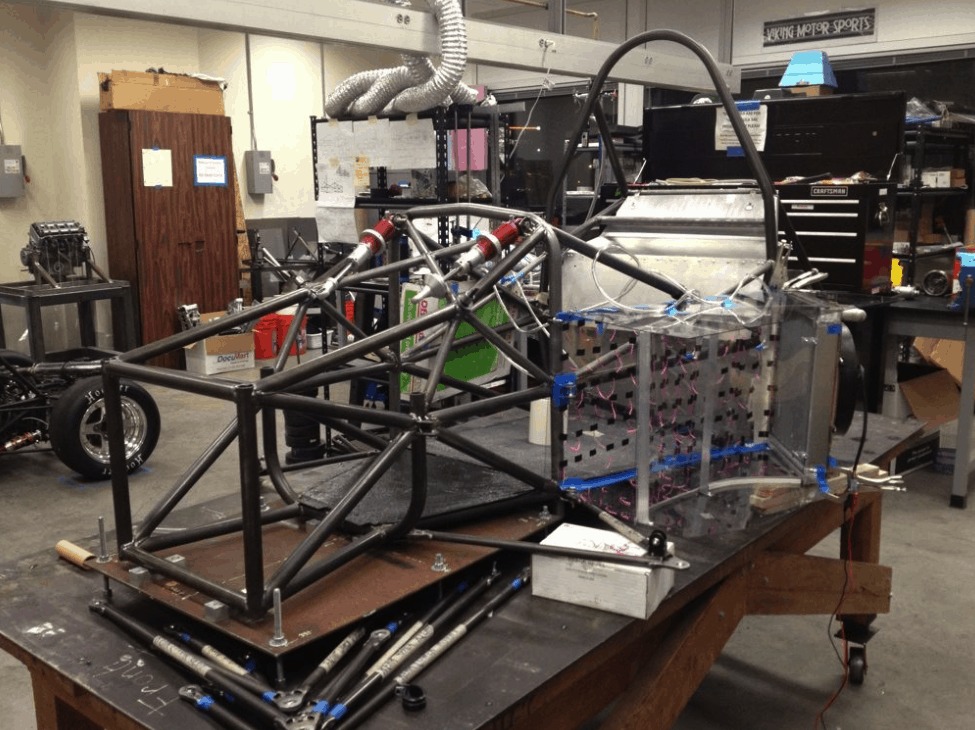
You only have a year with FSAE, which means we had to workย quickly. Within a few weeks the 2012 race car was beginning to take shape.

FSAE Race Car Frame

Remember: This wasnโ€™t built from a kit. From concept to 3D computer model to the immense amount of fabrication, we did it all. Not to mention the 12-21 credits of engineering classes, and on top of it all some of us were working an hourly jobโ€”myself included. Sounds crazy, huh? You have no idea unless youโ€™ve done it.

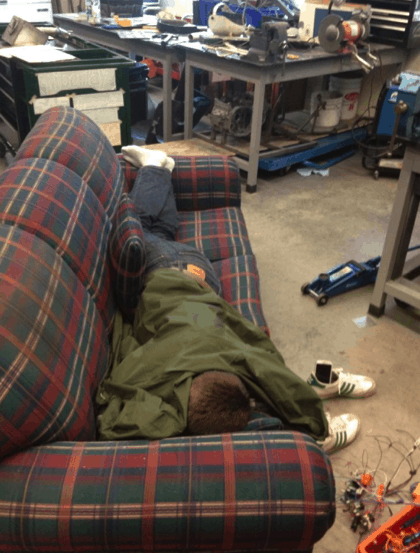
With a goal to have an operational race car by mid-February there were at least eight members spending 60-80 hours per week building the race car. There were many late nightsโ€”actually, “early mornings” are a better way to put itโ€”that ended like this:

Working Late on an FSAE Car

But with every toughย time there was a moment like this to remind us to have fun:

FSAE Fun Engineering

The Fruit of Our Labor

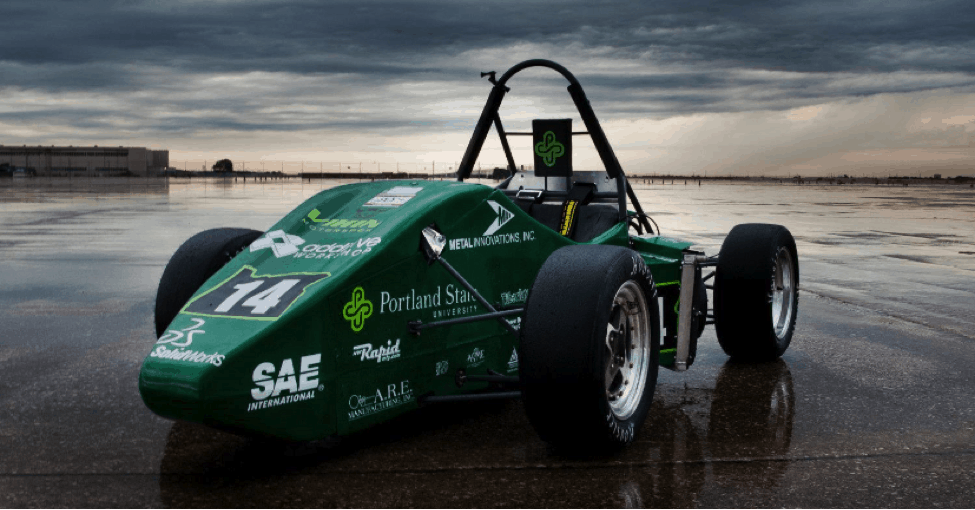
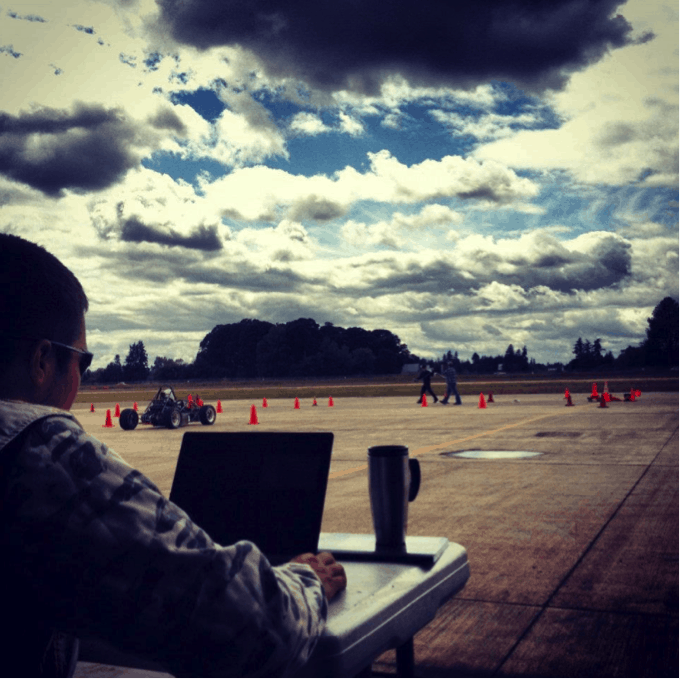
By March, only a couple weeks behind schedule,ย we hadย an operational race car, and we were feeling pretty awesome (to have an operational race car by thenย was impressive in this competition) and ready to start testing and tuning. With so much time spent in the machine shop and lab, we were all very excited to get some fresh air at the test track. Who wouldnโ€™t be excited with a view like this?

FSAE Race Test Track

Our testing and tuning consisted of every aspect of vehicle dynamics. Tire pressure, camber, caster, anti-squat, anti-lift, toe, spring rate, and damping rate adjustmentโ€”not to mention the live engine tuning via wireless connection. Testing and tuning days were an absolute blast, but they were packed full of problems and solutions, because that’s the reality of a race car. On top of our private testing and tuning, we would also participate in local SCCA autocross events, because it was more testing and great driver training. These events were usually a bit more relaxed if there werenโ€™t any issues.

The FSAE Competition

Letโ€™s fast forward a few months to the actual competition heldย in Lincoln, Nebraska.

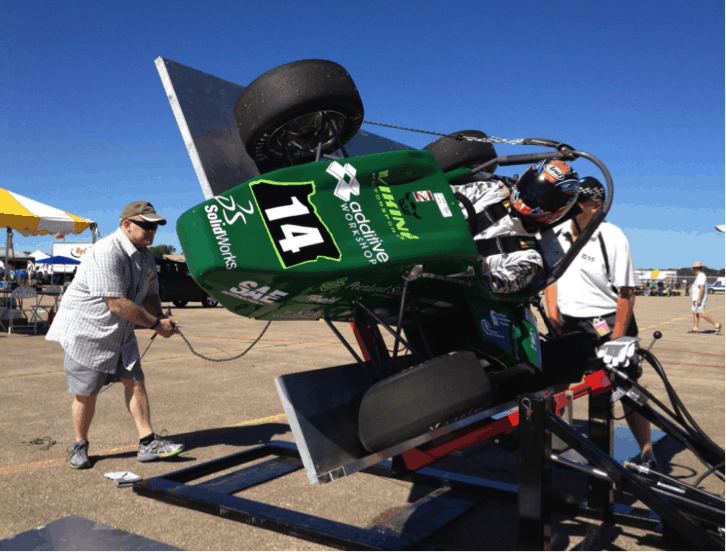
The most important step was getting through tech inspection. Tech inspection, or commonly called โ€œscrutineeringโ€, involved four stations, each testing a different aspect of the car. First, the car is thoroughly inspected by officials to verify all the rules had been followed. Second, accelerate for a set distant then apply the brakes at full force. All four tires must lock up and the race car cannot rotate out of control. Third, rev the engine to a set RPM for 3 seconds without overshooting the 110dB threshold. Fourth, the epic tilt table. The car and driver are tilted to over 60 degrees to check for leaks and to simulate a 2.5G cornering force. Sound nerve-wracking? It can be, but this is also pretty fun:

FSAE Testing

To our surprise, we were the third team to get through tech inspection. That may notย seem like a huge accomplishment, but you need to understand that some teams never even get through tech inspection at all. The tests are exhaustive, especially for college students who just built a racing vehicle from scratch. With the tech sticker on ourย race car we were off to prepare for the next few days of static and dynamic events.

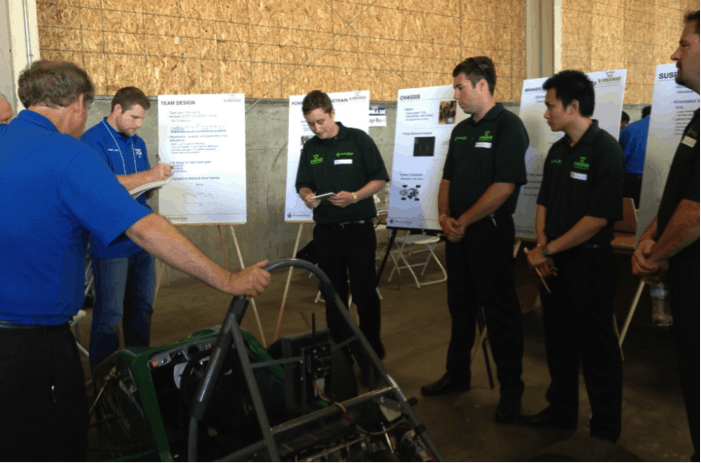
The next morning came,ย and the first event on our schedule was the design presentation. This was my biggest worry of the whole competition. Four very well educated and known motorsports engineers drill you for an entire hour with questions about your design and your decisions to get to that design. It was like standing in front of the firing squad.

Formal FSAE Design Presentation

All-in-all we did pretty well for being more of a hands-on focused team. The important thing was the most difficult event wasย behind us. Next were the other two static events, but I didnโ€™t present in these, so we will just move forward to the dynamic events.

Like any good race car it was having issues that we couldnโ€™t for the life of us diagnose. After limping the race car through the drag race and skid pad events, we narrowed the issues down to the fuel pressure regulator and a potential tuning issue. After completely re-designing the fuel system from an in-tank setup to an external setup we had the car running much better. There was still a mysterious tuning issue, but with only minutes to spare we pushed (all race cars had to be pushed to the events according to theย rules) the race car to the autocross event in an attempt at least score some points.

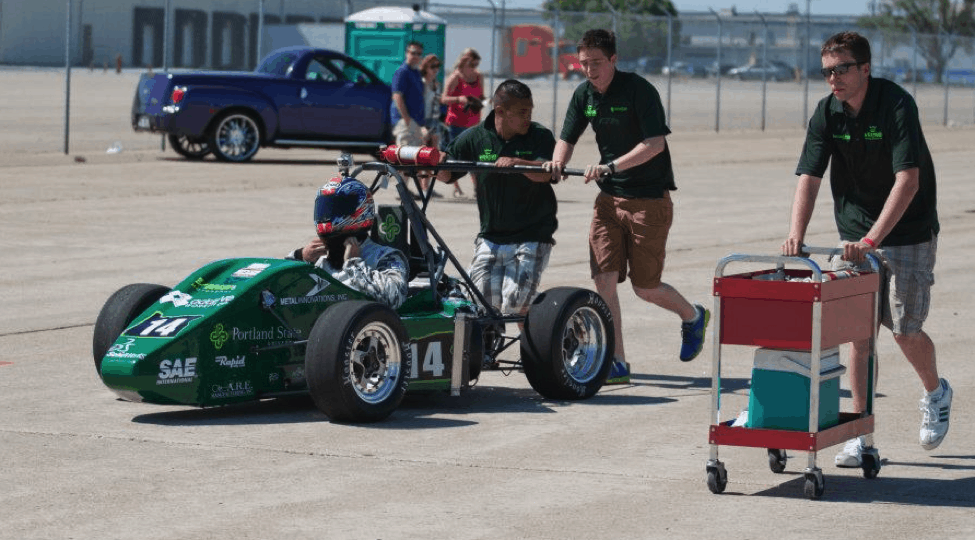
Pushing an FSAE Race Car

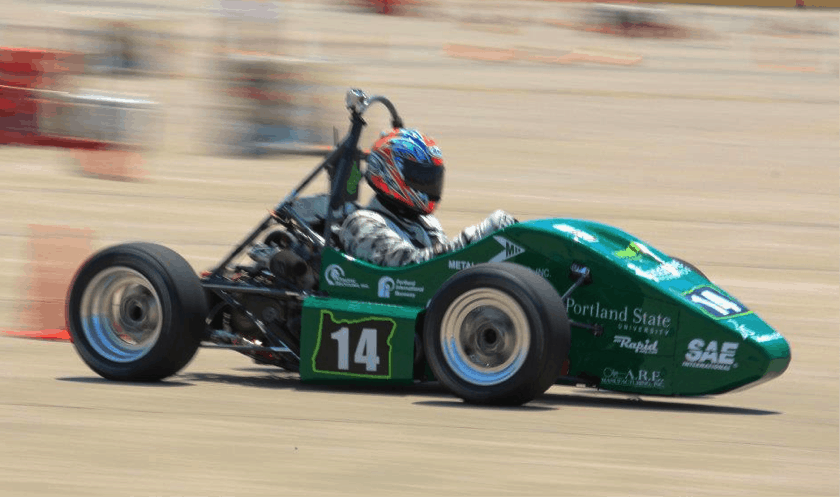
The race car was difficult to drive as the throttle response was poor to say the least, but I managed to finish 25th of 90. I laterย found out that this was the highest score for the autocross event in PSUโ€™s history.

Check out the Autocross event here. (Skip to 3:15.)

Last but not least was the endurance event. This event is worth 40% of the total competition points and is by far the most demanding dynamic event. On average, only 60% of the teams that start the event finish. The most common issues are engine overheating or failure to restart after the driver change, but sometimes you have an unusual issue much like the one we had to overcome. I was the first driver for the endurance event, so I was forced to improvise. The bracket that stops the accelerator pedal broke on my first lap, which resulted in the accelerator pedal being stuck wide open. I couldnโ€™t get my foot around the pedal to pull it loose, and quitting wasnโ€™t an option. With no other choice, I drove the next ten laps throttling through the corners with the clutch, leaving the throttle wide open. As you can see in the video, things got a little out of control for a bit, but I managed to finish my ten laps without blowing up the car.

The FSAE Endurance Challenge

We changed drivers and proceeded to complete the endurance event with a broken chain tensioner at lap 18. Through all those issues we finished 14th in the endurance event.

Check out the Endurance event here.

With all the points tallied up, we finished 16th place of 90 teams at FSAE Lincoln. This was and still is the highest placing in PSUโ€™s history. None of this would have been possible without the support of my fellow teammates and our extremely supportive adviser, Evan Waymire. Of course we learned a ton about engineering, but also, and maybe most importantly, that life is not about the issues you face, but about the ways you solve them.

Barett Strecker-01

The New CorkSport Mazdaspeed 3 Hood Scoop

Look good and drive better with the latest version of our 2010-2013 Mazdaspeed 3 Hood Scoop!

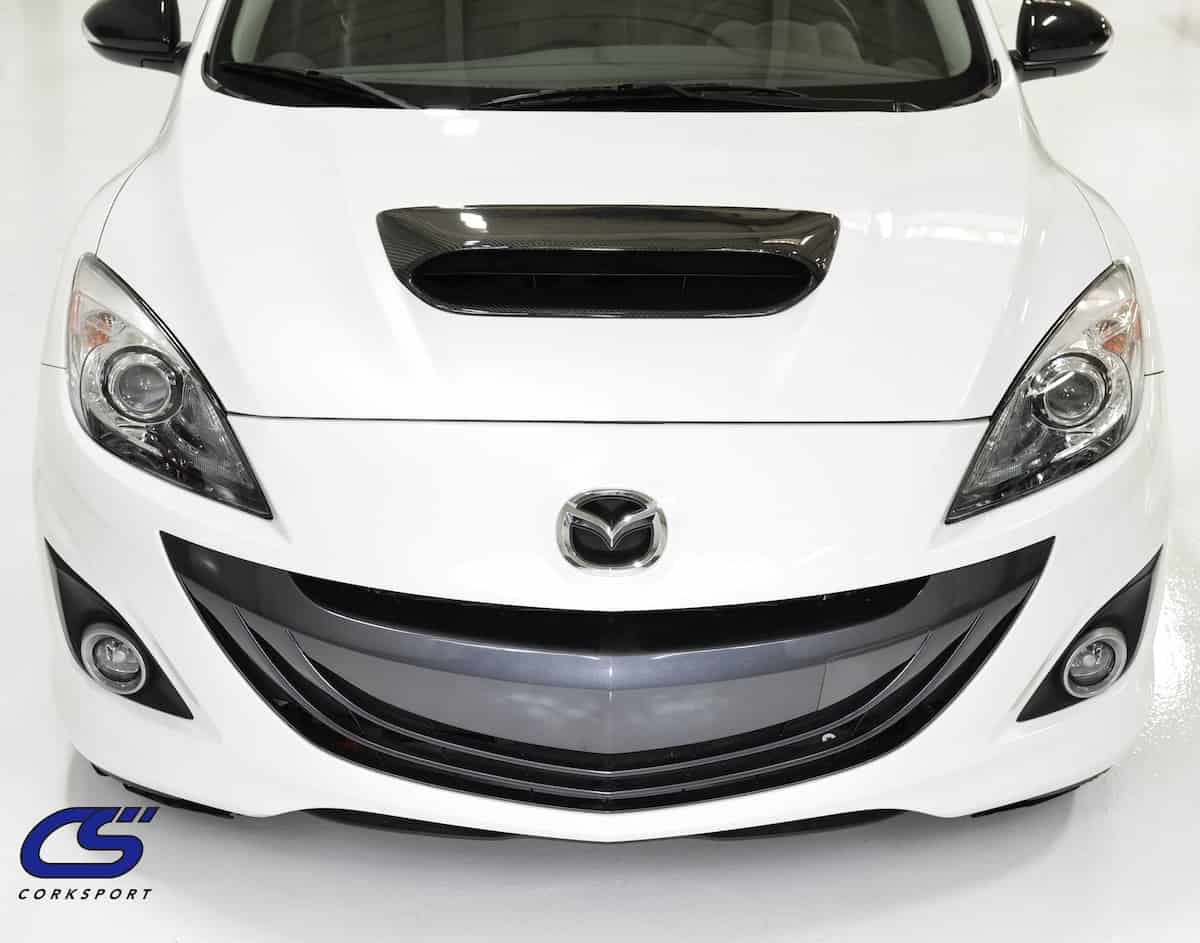
CorkSport Mazdasspeed 3 Carbon Hood Scoop Installed

Would you look at that beauty?

The CorkSport Hood Scoop has a mirror-like finish, giving yourย Mazdaspeed 3 a clean, styled look that’s as practical as it is fresh. With a 52% larger opening than the OEM hood scoop, you’ll increase the cold air inflow to your top mount intercooler. Boost air temperatures will drop, which means more power to the engine. You’re going to turn heads, and feel a difference in performance.

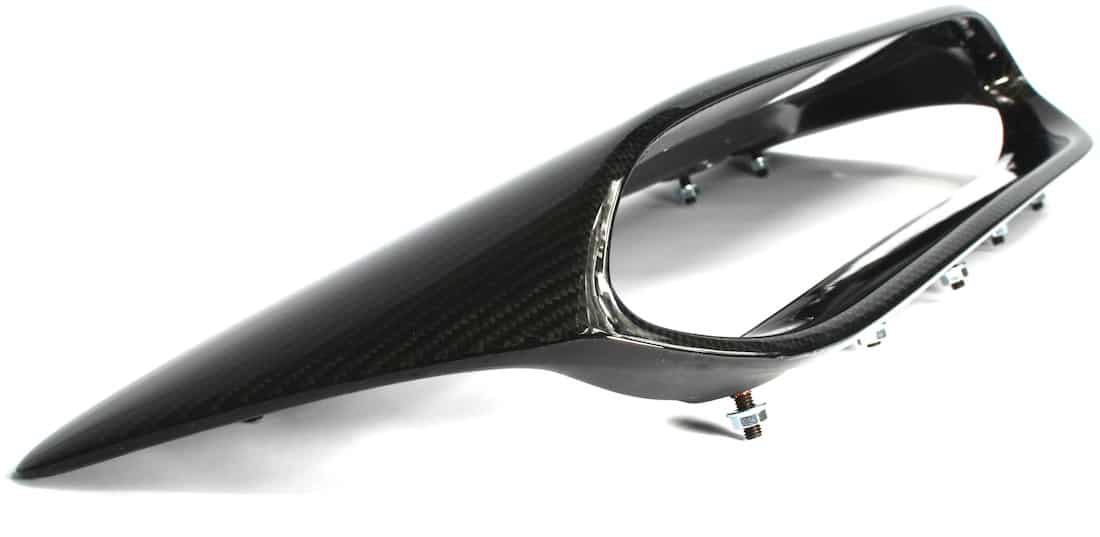
Increase Mazdaspeed 3 Cold Air Intake scoop

We engineered this to an exact fit, meaning, if you follow the instructions, installation shouldn’t take you more than half an hour. Oh, and the fiberglass is overlaid with real carbon fiber cloth and sealed with UV-resistant, epoxy resinโ€”so it won’t lose its shine anytime soon.

UV-resistant carbon fiber hood scoop for the Mazdaspeed 3

Convinced yet? Yeah, we thought so. Check out the 2010-2013 Mazdaspeed 3 Hood Scoop product listing page for a few more nitty-gritty details,ย and order yoursย today!

Connect with us

You may also like

Stay up-to-date on the latest news and product updates from CorkSport.

* indicates required

Fast Facts about the New #CorkSport Shirt

Look good while you drive good (and do other stuff good too) with our new #CorkSport hashtag t-shirt.

Standing in style with the new #CorkSport t-shirt

#CorkSport says a lot in one word: That you care about quality; that you’re passionate about Mazdas; and that power and speedย are some of the most important things in lifeโ€”or at least driving. So why not tell the world you’re a Mazda head with this shirt?

Available in white:

White CorkSport Shirt

….and black:

Black CorkSport T-shirt

…so youย canย look good before or after Labor Day.

Now, onto the nitty-gritty:

  • CorkSport Service & Support:ย The advantage of the CorkSport hashtag shirt is that it comes in two colors and multiple sizes. Choices, guys.
  • OEM Fitment:ย The shirts are a 60/40 cotton/poly mix.
  • Track-Tested:ย We have personally worn these shirts at the track, and they hold up great to working conditions and make you look good..
  • Dusting:ย There is no dusting under heavy performance with these shirt.
  • All-Weather Performance:ย If it is raining or snowing and you are wearing just this shirt you will get wet. Sorry folks it cannot do everything. Your hair will get wet too.
  • Hashtag Obligation:ย Usingย the CorkSport hashtag willย not improve the comfort level of this shirt, but you should use it anyway.

Any other questions? All right, now go getย yours.

You Asked, We Answered: Our 2nd CorkSport and Mazda Q&A

Corksport Q&A

In January, we wrote a post answering questions our fans asked. It went over so well we wanted to do it again.ย Here are the top 7 questions we found on Facebook, Instagram, and Twitter:

Question:ย Would you guys consider making a turbo kit for the SkyActivย engines? What challenges would you face with that engine compared to the MZR engine?Screen Shot 2015-01-21 at 12.34.32 PM

  • Questioner: Michel Balk
  • Answer:ย There are a few key factors that would prove difficult to overcome when turbocharging a Skyactiv-G engine. First is the extremely high compression ratio of 13-14:1. High compression ratios and boost donโ€™t mix well, and the supporting engine design to run that high of a compression ratio is very sensitive to major engine changes. For example: The exhaust manifold is a very well-engineered 4-2-1 design that is critical to running a high compression ratio on 87 octane fuel without pre-detonation. A typical turbo kit would replace the exhaust manifold which could cause many unknown issues. Second comes down to the overall design of the engine. Mazda has made it very clear they are chasing fuel economy, not white knuckle power. So, looking at that goal from a business standpoint, why would Mazda design the engine to handle 250+hp? That would only cost them more money. The engines are lightweight in every aspect: bearing size, connecting rods, pistons, crankโ€ฆthe list goes on. The SkyActiv-G engines are not built for power. Lastly, what good is a turbo kit if you canโ€™t tune it correctly? As of right now there is not an effective method to tune the SkyActiv-powered vehicle. Itโ€™s unfortunate, but a turbo SkyActiv-G is a long shot.

Question:ย Give us all the info about the new CS turbo in production!

  • Questioner:ย Jeromy Williams
  • Answer: Well I canโ€™t go and spill the beans, but I can give you a few tidbits of information. The goal of this turbocharger is not huge power numbers. Actually I would be in shock if anyone could get this to push 400whp with meth. The goal is to provide a turbocharger that cost only slightly more than a new K04 Turbo and is 100% bolt on. When I say bolt-on, I donโ€™t mean โ€œbolt-onโ€ like BNR and ATP define it. This turbocharger requires no modifications to your current intake and exhaust systems; and no modifications need to be made to the oil and coolant lines. Itโ€™s like swapping in a new K04, but with much more power potential and no blue smoke. This effectively makes the turbocharger cheaper for the customer because none of the supporting sub-systems need to be upgraded or modified. As for some specs: Power is comparable to a BNR S3, and full spool is in the 3000-3200RPM rangeโ€”depending on vehicle components. The current tune on my car is reaching 21PSI at 3200RPM with the CS EBCS running in bleed setup, and thatโ€™s on the prototype turbo without the billet compressor wheel.

Source: Autoblog
Source: Autoblog

Question:ย Will you be doing more products for Miata?

  • Questioner:ย Steve Linnehan
  • Answer:ย We are very excited about the new MX-5 Miata hitting ourย shores in the near future. The CorkSport sales manager is going toย buy one as soon as possible. We plan to produce a respectable lineup of performance products for the new MX-5 Miata. From suspension to power, we will help you put some more pep in the Miataโ€™s step, so stay tuned!


Mazda 3 Exhaust SystemQuestion:ย What do I need to put more HP on my 2012 Mazda 3 2.0i SkyActiv?

  • Questioner:ย Brayam Calo
  • Answer:ย CorkSport has a couple options for your dilemma, Brayam. Combining our SRI, Cold Air Box, and Power Series Catback Exhaust System showed impressive gains for the little 2.0. On our dyno, the stock 2.0 made 118hp/110lbft, but when we added the components above, we saw power increase to 135hp/123lbft. This is a respectable increase in power for a naturally aspirated engine.

Question:ย What is an approximated max horsepower output that can be produced in an MS3 without upgrading turbo back?

  • Questioner:ย Christopher DeCaro
  • Answer:ย This is a difficult question to answer accurately as there are so many factors that play into the maximum power of an engine. The OEM downpipe is extremely restrictive on the MS3 and is commonly recommended as one of the first upgrades. Our dyno testing showed a 50hp increase over stock with only a Stage 2 intake, downpipe and racepipe installed. So as you add more components and eventually go with a larger turbocharger, the loss in power from the OEM downpipe will only increase.

Question:ย Is there a way to have the engine RPM drop faster while shifting or revving from an idle?

  • Questioner:ย Matt Zoomin Brown
  • Answer:ย The rate at which an engine can rev up or down comes down to simple physics: โ€œForce = Mass x Accelerationโ€. You often hearย of people upgrading their flywheel from the OEM steel piece to a lightweight steel or aluminum/steel two-piece flywheel. By reducing the weight of the flywheel and the rest of theย rotating mass of the engine, you effectively reduce the amount of energy needed to make the engine rev up. The opposite works for revving down. The greater the mass of the rotating assembly, the more resistance need to stop the rotationโ€”or the longer it takes to spin down. This is a result of the โ€œMoment of Inertiaโ€ of the rotating mass.

Question:ย I would like to turbo my 2010 2.5 N/A Mazda 3, what do I need to know?

  • Questioner:ย Cynthia Senger
  • Mazdaspeed 3 is the better turbo choiceAnswer:ย Like everyone else Iโ€™m going to recommend you sell your car and buy a car that was turbocharged from the factory, but for the sake of argument and fueling the fire I can point you in the right direction. The 2.5 N/A engine and the 2.3 turbo engine are very similar in design. I would start with buying a blown turbo engine, removing the exterior components, and then modifying them to work on your engine. Now the easy part is doneโ€ฆ Next, you will need some way to tune the vehicle because turbocharging an engine that was not designed to be turbocharged is not a simple bolt-on affair. If you get past these two major hurdles, then bravo! Unfortunately, unless you improved the engine internals to handle this power, the engine will probably not liveย long with the added stress of itsย newfound power. Back to the first option: Buying a Mazdaspeed 3 makes a lot more sense in many aspects. Reliability, durability, and aftermarket support make big power much easier to achieve. Granted, a Mazdaspeed 3 may be more expensive to buy upfront, but I am almost certain it will be cheaper in the long run and will come with far fewerย headaches and days without a car. I wish you the best of luck!

Thank you for your questions and keep themย coming. We’ll have a Q&A every month for your Mazda performance questions.

#ZoomZoom

Barett Strecker-01