I was looking at the Mazda Japan website the other day and noticed that there is now an option for a Mazda 3 gasoline hybrid listed. Years ago Mazda announced that they were working with Toyota hybrid tech and this looks to be the result.
There isn’t a lot of detail listed with the description of the model so I decided to do a comparison of the Mazda 3 against the current model year of Prius as the 2 vehicles are most likely running the same hybrid drive setup.
Price: With the current exchange rate the Mazda 3 hybrid is ~23500 which is almost the same as the current Prius price shown of ~23475. You get more car with the Mazda 3 for the price and a car which handles like a car should. Win here for the Mazda.
Styling: Right away I can tell you I prefer the styling of the Mazda 3 over the Batmobile inspired Prius which looks like someone used a late 50s Chevy and applied the styling.
Fuel Economy: This one is the funniest thing and really shows where Mazda’s engine tech is beating all of the other manufacturers. Toyota Prius 1.8 hybrid gets 56mpg in combined city/highway. Mazda 3 2.0 hybrid gets 63mpg. Caveat on this data, I took the economy listed on the Japanese page and converted it to MPG so they are not based on the same drive cycles.
If your Japanese skills are on point check out the landing page for the 2018 Mazda 3 Hybrid yourself here. Just a note google translate won’t let you convert the page due to SSL from Mazda’s page.
So you are asking why do I care about a hybrid and in all honesty I probably won’t own one myself but if it does happen I prefer to at least own one that handles worth a crap and has decent driving dynamics. I can’t say I have ever heard anyone raving about how good the chassis is in a Prius.
-Derrick
*Pricing reflects the current price at the time of writing
All CorkSport products go through an extensive process to ensure they are the best fitting, looking and performing parts that they can be. As a product development engineer, I see all of these steps on a day-to-day basis, but we don’t often talk about how an idea evolves into a CorkSport part. Sit back and read on as I give you a glimpse of what goes on during CorkSport R&D.
Concept and Planning
All parts start out as an idea. They come from many sources: employees, forums, car shows. One of our biggest sources of ideas is YOU! Check out the blog on submitting product ideas for more info on how our customers give us their thoughts.
At the beginning of each quarter, all product ideas are evaluated to determine which are feasible and which are going to be pursued moving forward. After the extensive list is narrowed down, they go into a more in-depth evaluation.
This includes defining the scope of the project, how many man hours it is expected to take, evaluating all expected costs of production, and setting a retail price. Without this evaluation, we would encounter all sorts of roadblocks along the way that would delay getting parts out to you all. If everything is looking good, the project is approved and moves forward.
R&D Begins
At this stage, it’s time to get our hands dirty (literally in some cases). First, we investigate the car the part is for and the scope of the project to understand exactly what the goal of the part is. Doing this allows us to find all design constraints and look for things we may not be expecting. Replacement part diagrams and factory service manuals can be vital here, especially if we do not have a Mazda or Mazdaspeed readily accessible.
By now we usually have a good idea of what features we want the part to have and can move forward with creating an “MVP”. A minimum viable product is just what it sounds like. Not necessarily pretty or optimized yet but good enough to get to see if an idea will work and to check fitment. During MVP creation we have to consider all design constraints, desired features, integration with other CS parts, and even how to manufacture the part. Check out the changes below from an early MVP to the final design for our GEN3 TMM.
If the part can be 3D printed, we print the initial MVP and test fit. Test fits are by far the most unpredictable part of the whole process as sometimes we discover an issue that can change an entire design. Depending on the part, we can have one test fit and be good to go or four and still have work to do. Once we have revised the MVP to a point where it fits well, looks good, and can be manufactured relatively easily, a functional prototype is produced.
Functional Prototypes
This is where the fun really begins; test fitting is a 3D print is one thing, having the part made out of metal is a whole new story. Depending on the part, we sometimes have to skip directly to this stage as it cannot be easily printed in-house. We always have to be careful doing so to limit the number of expensive prototypes we have made. Sometimes this goes well, other times not so much… This swaybar prototype was limiting suspension travel.
A functional prototype also allows for any testing that we may do. Whether it be on the dyno, track, or on the street, all CorkSport parts are used and abused to ensure they hold up to what you can throw at them. Check out an early CS Throttle Body getting tested on a flow bench.
If we are happy with a prototype, this is where you all can get involved again. We often use “Beta Testers” to get another opinion on the part and to see if they come across any issues. From here we sometimes have revisions that need to be made and another prototype produced but ideally, we are ready to move on.
Manufacture & Prep for Release
From here we move to getting the parts made. Sometimes this is a process that only takes a few weeks, other times it takes many months to complete. The manufacturing method, type of part, and order quantity play a big role here. Additionally, some products have a lot of different parts to make up a whole CS product, so each individual part takes time. Sometimes, we even get to see something unexpected, like these Command Wheel Covers before getting anodized black.
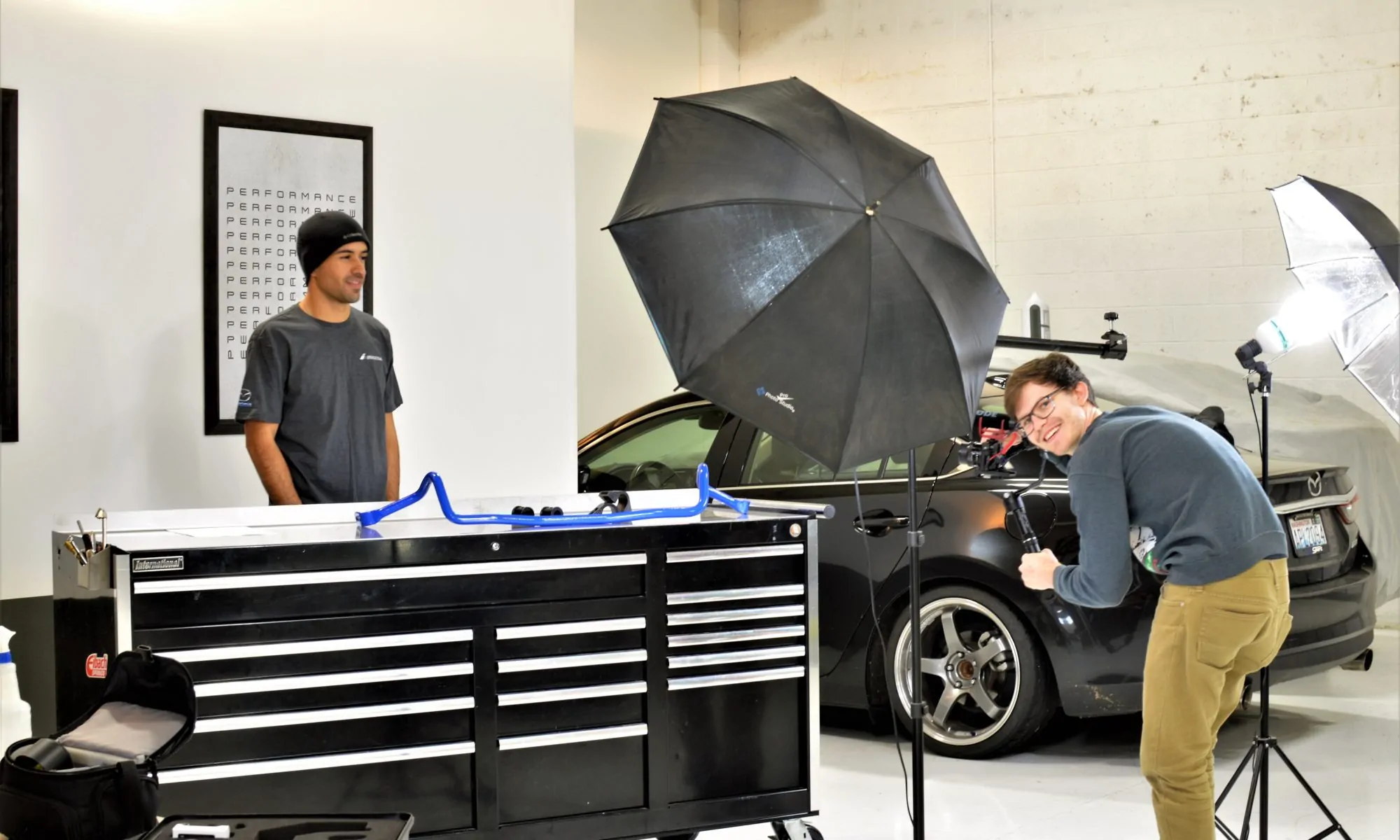
While all of this is going on, we are also preparing the product for release. That way, when our manufactured parts show up, we are ready to send them out to all of you. Installation instructions are created, QA checks are set up, laser etch files are set up, product images and video are taken, the web page listing is set up, and so on. Any and all of the content you see on a product is all created in-house. Engineering school definitely did not prepare me for shooting high-quality photos and video!
Check out a “behind the scenes” look at one of our videos:
At this point, we are pretty much ready to bring the new CorkSport Mazda or Mazdaspeed part out to you all. Throughout this process, we are constantly thinking about the experience someone has when they buy the part to ensure it is something that we would be proud to have on our own cars. After all, we build our dream cars using CS parts just like you do!
-Daniel
An Inside Look at CorkSport R&D September 13th, 2018Derrick Ambrose
I recently got a good dose of nostalgia when I agreed to help my dad pick up his new (to him) car, a 323 GTX. A longtime friend of mine had one sitting in his driveway looking pretty sad and I had mentioned it in passing to my dad that he was looking to sell it.
Like most GTXs you find for under ~1k they need some love and this car was no exception and it needed to be towed home.
After spending an hour looking the car over once it was home I realized home much I still remembered about these cars. Honestly, it has been 7 years since I looked at a GTX in person and the floodgates in my mind popped open with piles of information on what we needed to check out first in the car.
As we continued to look over the car, answers to why things were not working just came right out. A good example is why does the cooling fan turn on when you crank over the engine? I didn’t even have to look, I knew there are several sensors which the car looks at to #1 turn the fan on and #2 what speed to run it at based on temperature, the A/C is turned on, etc. Turns out the car didn’t have either of the two temp sensors plugged in or they are broken.
As we went over the car I was listing off items we need to check or replace to get this car back up and running as it should be a funny feeling came over me. I really felt good to be working on one of these cars again. This time the money pit isn’t mine thankfully, but if I ever want to get that “good old days” feeling from my early twenties all I have to do is go over to my dad’s house and pick up a wrench as there is almost certainly something which will need to be fixed.
The fun part of this adventure is the answer to why did he buy it. Like most 323 GTXs they are meant to be raced and this is no exception as it will be run in the Gambler 500. Never heard of the Gambler 500 before? Well, it is like chump car or Lemons racing, you can prep a cheap car and go rally racing with it. Having a ~500 car survive the weekend of navigating GPS and not breaking down in the middle of nowhere is the challenge.
Some of you remember my old GTX which was sold to another local GTX aficionado sitting in the normal position of being broken and needing time and money thrown at it to get it back on the road again. If you haven’t seen the car before here is a few pictures of it in it’s natural habitat which I have dug up.
If any of you decide to pick up a GTX, remember it doesn’t take much to get your 323 to do this and not leave the transmission in pieces….
-Derrick
Mazda Nostalgia – 323 GTX January 13th, 2020Derrick Ambrose
The GEN2 Mazdaspeed 3 has a lot in common with the Mazdaspeed 6 and the GEN1 Mazdaspeed 3 when referencing the engine and transmission. However, there were a few things that Mazda did change and improve when they gave the Mazdaspeed 3 a facelift in 2010.
Some of these changes include the valve cover, the gear ratios in the transmission, the power steering system, and the oil filter assembly. This last one is the one I want to talk about today.
Perhaps you just ran across this blog while googling how to change the oil in your Mazdaspeed for the first time or maybe you’ve already done a handful of oil changes. Either way, you can benefit from this info, unless you already have a 2010-2013 Mazdaspeed 3 you lucky bas****. All you Mazdaspeed6 and GEN1 Mazdaspeed3 owners listen up.
This is what you’ll find on your pre-2010 Mazdaspeed 3 and all Mazdaspeed 6; it sucks. This design uses an internal filter element only which is fine, but the OE housing cap is a real PITA to remove from the car which makes a simple oil change a much more frustrating process than it should be.
Along with the difficult disassembly, there is a limited number of filter options compared to the modern canister design. Luckily, the oil filter housing found on the 2010-2013 Mazdaspeed 3 utilizes a modern canister oil filter and is a simple bolt-on affair.
Mazda part # L311-14-311A is the part you’re looking for and can be found online or at your local Mazda dealership. It’s also wise to get a new gasket for the installation; nobody wants to do a job twice. This is Mazda part # LF02-14-342.
Once you get your parts and all your oil and a new modern oil filter, you’re ready for the big install. It’s actually really simple, only adding about 30 minutes to your oil filter change. Remove the fluid-to-fluid heat exchanger (the black thing on top with the coolant ports), then pull the housing off the engine and swap over the sensor. Back on the car with the new gasket and you’re good to go.
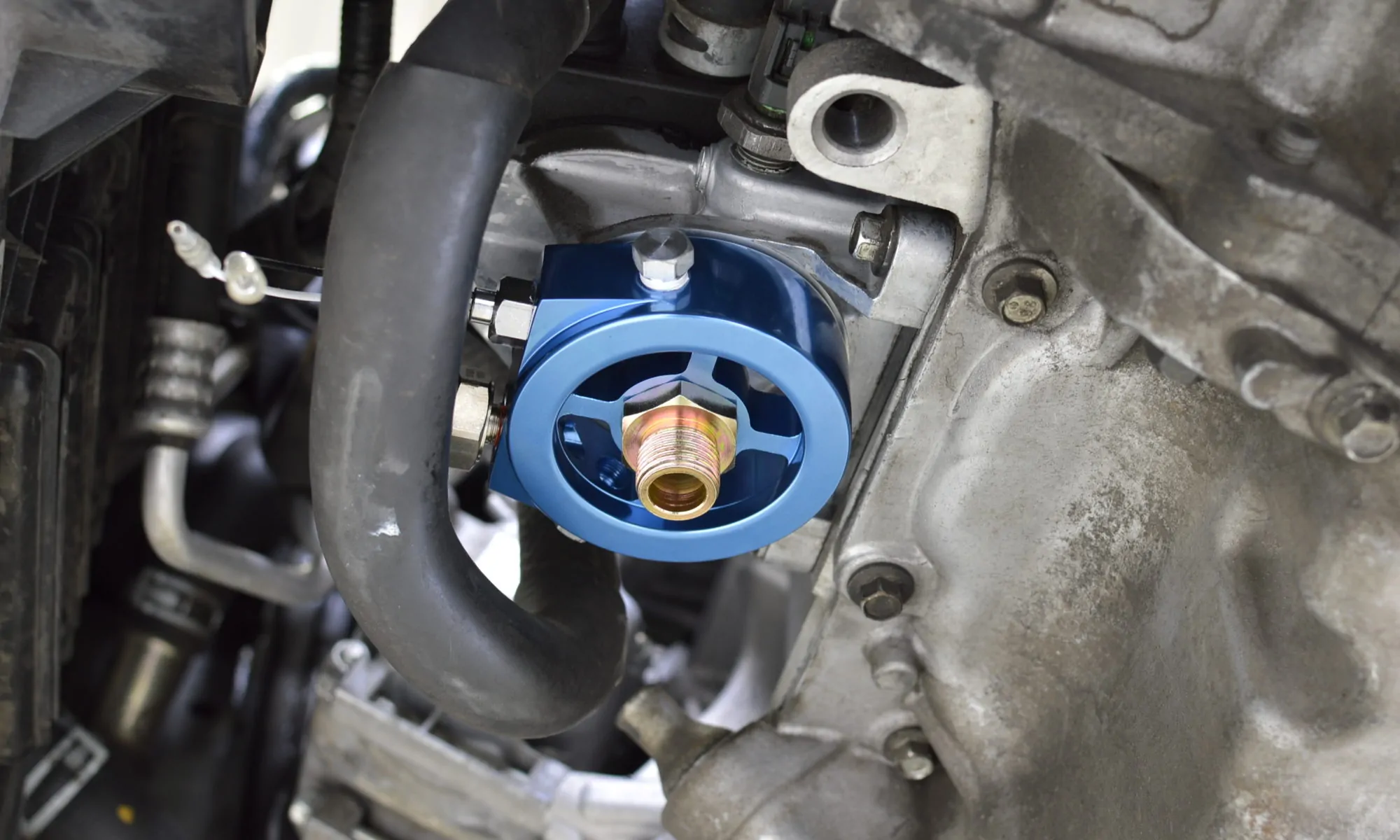
Another great benefit of the modern oil filter canister is the ability to use an oil filter plate to provide sensor ports for gauges such as oil pressure and oil temperature.
This sums up the oil filter housing swap; it’s really just that simple. So if you have an oil change coming up and aren’t one of the lucky ones with the GEN2 Mazdaspeed 3, then consider this before you get started. I promise you won’t regret it.
-Barett @ CorkSport
Oil Filter Changes Made easy for your 2007-2009 Mazdaspeed 3 and 2006-2007 Mazdaspeed 6 August 3rd, 2023Derrick Ambrose
If you have been in the car scene for a while, you have probably seen or heard of performance exhaust manifolds. Like any other component on the engine that affects flow, performance exhaust manifolds can have a significant improvement to the engine’s peak performance and power under the curve amongst other aspects that the exhaust manifold can affect.
You have also probably asked the question. “What type of exhaust manifold do I need?” In this blog, we at CorkSport would like to help you better understand the differences between cast and tubular so you can make the best decision for your Mazdaspeed.
There are two main styles of performance exhaust manifolds; tubular and cast. Both have their pros and cons to consider as an end user (that’s you the enthusiast) and as the designer/manufacturer (that’s us at CorkSport).
First, let’s look at tubular as it’s the most common in the performance industry. Tubular is the most popular option because of its manufacturing flexibility. Unlike casting, tubular does not require expensive molds to develop even a single prototype. Not needing expensive molds allow great flexibility in design and manufacturing, which lends the tubular manifold as an exceptional option for one-off builds.
To fabricate a tubular exhaust manifold you need just the raw components: flanges, tubular sections, collector and fabrication supplies, and of course the expertise to fabricate the manifold. Let me emphasize the necessity of fabrication skills here. To produce a reliable and performance-proven tubular exhaust manifold takes the correct skills, tools, and patience…it’s honestly a work of art.
With this work of art does come some compromises. To create the necessary runner routing, many tubular sections will need to be welded together. This increases the chance for weld impurities and slag which can later result in cracking and poor performance. Any reputable fabricator should be able to avoid this, but it does come at a premium due to the many man hours that must go into each and every manifold.
Next up is cast. Manufacturing via casting provides a different set of opportunities and difficulties to overcome. The process of casting alone has restrictions that must be considered, such as mold design and molten flow in the casting. Assuming these issues are overcome, casting can provide unique opportunities for the design to improve reliability, performance, and packaging.
A well-designed cast exhaust manifold can have great reliability due to its one-piece design. There are no welded joints that can crack or fail and casting typically has a higher threshold to heat before issues arise. The wall thickness of the casting can also be defined for the application which can improve strength if the exhaust manifold is the only part supporting the weight of the turbocharger.
Overall performance can also be affected due to the casting design flexibility with each runner. Unlike tubular, a cast is not restricted to standard tubular elbows and straits. The runners can bend and change profile as desired to aid in performance and packaging.
Speaking of packaging, casting can really change the game here. Since each runner does not have to be accessible for welding, the entire design and each runner can be tightly packaged together to reduce the overall size of the exhaust manifold and better retain heat which aids with turbocharger response.
Lastly, comes the cost to you, the enthusiast. Although the upfront cost of a cast manifold can be high, typically, the unit cost and necessary man-hours are low, which helps keep the cost down for you.
As a designer and manufacturer of performance parts for your Mazdaspeed, these are all things we have to consider providing you with the best parts possible. We’ve explored both and are happy to stick with casting as we feel it provides the best balance reliability, cost, and performance. Keep a look out for future projects and updates!