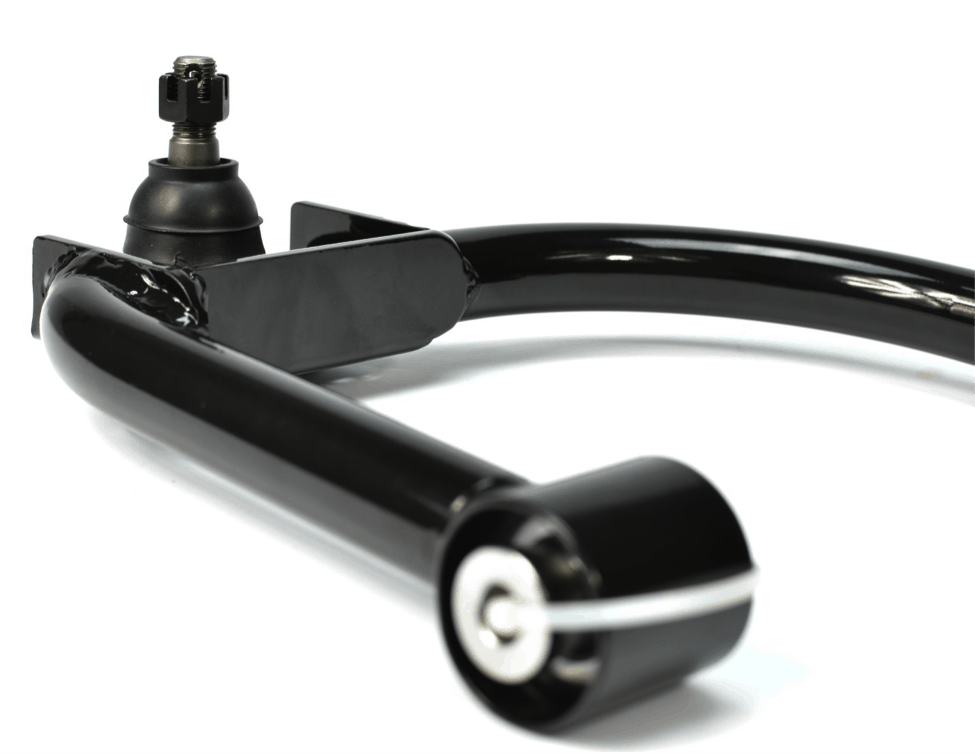
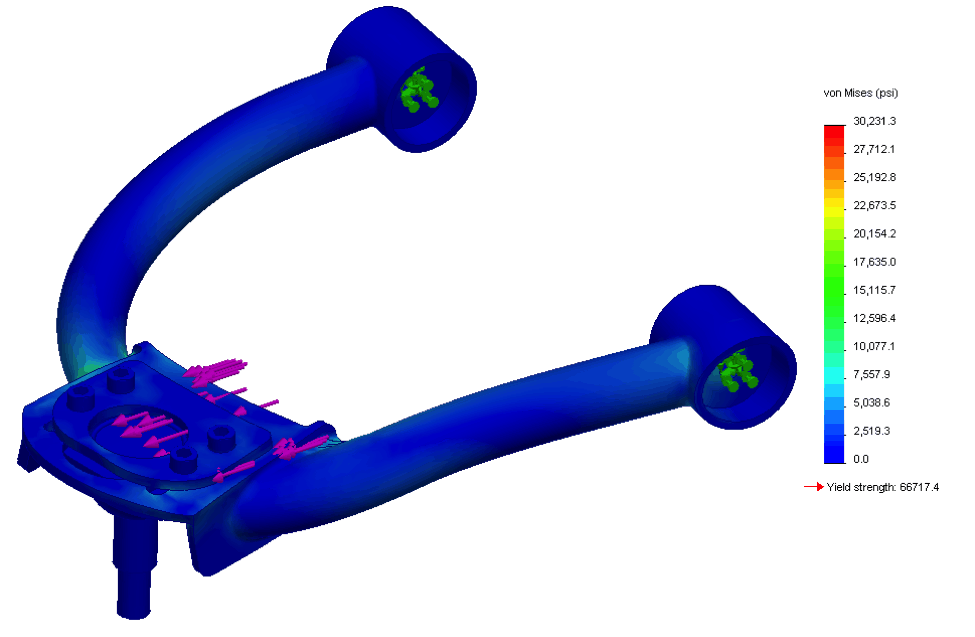
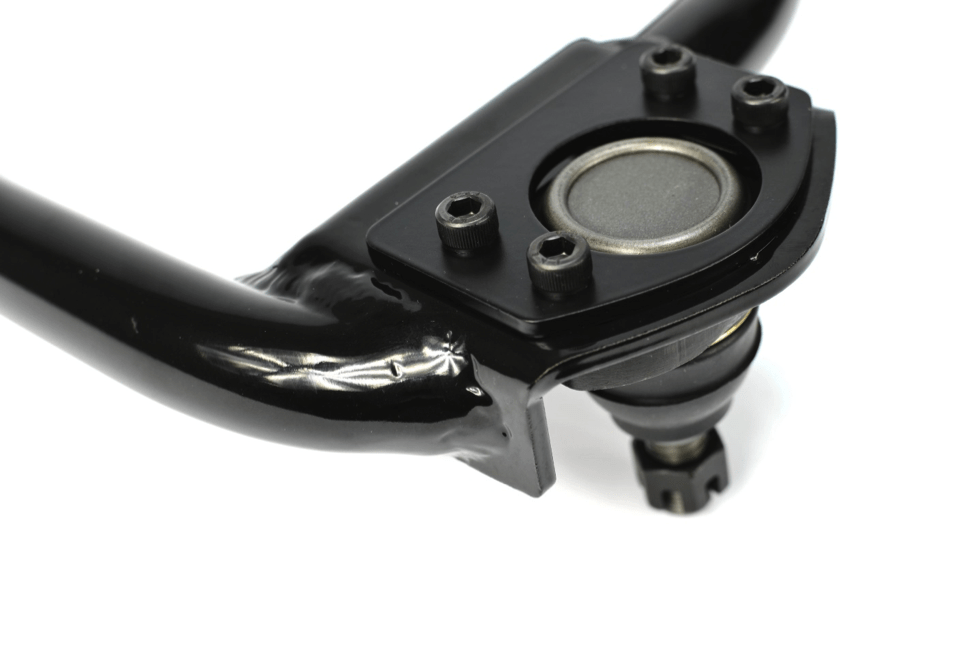
Our new front camber arms are manufactured from A513 steel and powder-coated black for long-lasting durability. The design has been FEA (Finite Element Analysis) tested and beta tested for strength and durability. Below shows the FEA with 780 lbf (0.87g lateral cornering force) applied to the ball joint (magenta arrows) with the arm pivot points fixed (green arrows). A force of 780 lbs was the result of Road & Track Magazine’s maximum corner force of 0.87g lateral in a stock Mazdaspeed 6.
The resulting FEA shows a maximum stress of 30k PSI, with the yield strength of the material being 67k PSI. Therefore, the control arm has no yielding at the stock Mazdaspeed 6’s maximum cornering force. Remember, this is a worst case scenario, because one control arm will never need to endure the entire car’s corning force. Ultimately the design has a minimum factor of safety of 2.21.
Probably the most exciting feature of the CorkSport Mazdaspeed6 control arms is the camber adjustability. With an adjustment range from -0.2 degrees to -2.0 degrees, you are sure to find a setup that fits your needs. So don’t wait! Get your adjustable front camber arms here, before they’re gone!
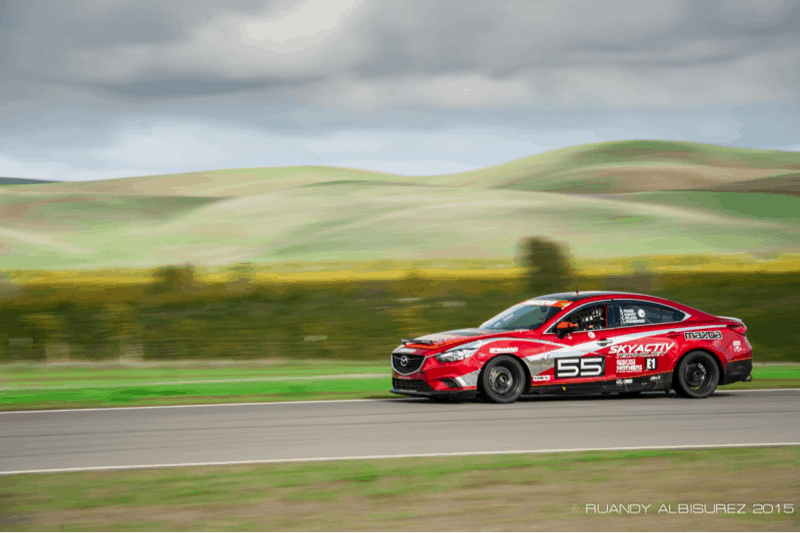
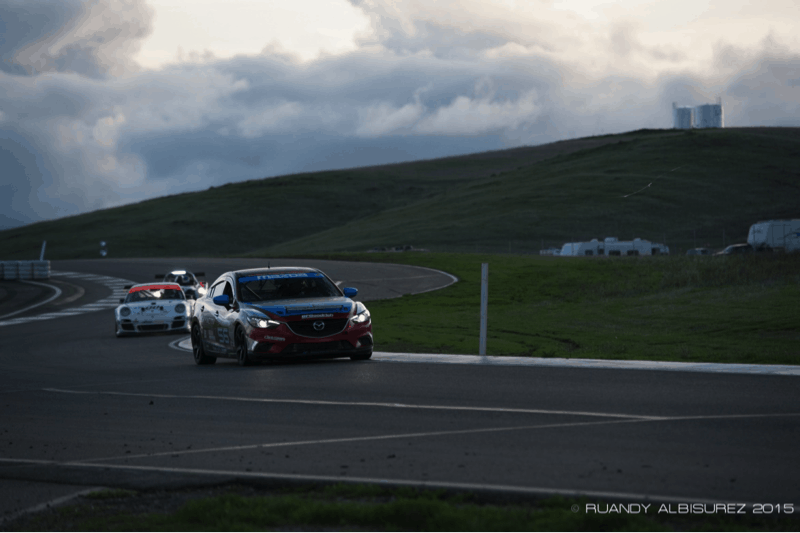
Not too often do you get a chance to cage up your family sedan and “run what you brung,” but that’s exactly what Mazda and Robert Davis Racing (RDR) did in the 2013 NASA 25 Hours of Thunderhill. Mazda took three brand new Mazda 6 Skyactiv diesel sedans out to the track and ran them. There were a few on-track incidents in the 2013 race but nothing too serious. Mazda was lining up to run the cars again in 2014, and several things fell into place that allowed CorkSport to provide some additional power improvements to the cars. We outfitted them with a downpipe and exhaust made from 80mm stainless steel, a high flow intake system, an upgraded intercooler and piping, and some ECU tuning. This gave the cars more power to stand a shot at the podium in E1 with better fuel economy than the other class cars and more power than the previous year.
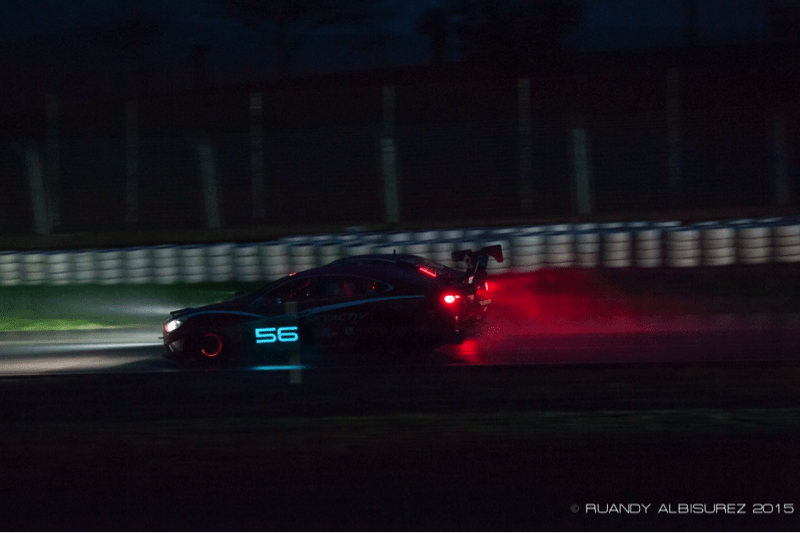
Inside the group of three Mazda Sedans was a rivalry of the Mazdaspeed Guys (comprised of Mazdaspeed Motorsports employees) and the Dealers CEB (Crayon Eating Bastards), a group of Mazda dealership owners/employees. The dealers controlled cars #55 and #56, and the Factory Guys (Mazda Employees) had #70, all fighting it out for bragging rights. Before the race got going #70 hit a snag where a coolant line came loose and overheated a motor, which prompted a Thursday motor change.
By Friday the cars were all in good shape for qualifying. This went down trouble-free despite a giant rainstorm, as if it wasn’t hard enough trying to run a fast lap with 58 other cars out on the track in six classes— all of which had different speeds.
Thankfully, by Saturday morning the weather had cleared up, and the forecast predicted dry racing for the full 25 hours. This prompted us to get the three cars ready to run on slicks which were mounted up on the wheels and installed on the cars.
Right at 11 am the flag dropped and started the longest race in North America. This was, needless to say, an adventure for the whole team. Several hours into the race, the driver of #70 reported that the car would not shift into all of the gears. It turns out the extra power was a little harder on the drive train in the higher gears, which removed the 5th gear from being functional. The driver decided to stay out and run the race in 6th gear until the fuel stop came up. That turned out to be hours later courtesy of the excellent fuel economy of the Skyactiv engine. The pit area was prepped for a transmission swap with a spare gearbox the team had brought with them. Unfortunately, this took the car out of any chance of being on the podium, but with endurance racing you never know what will happen! So the transmission change went ahead as planned.
At the first extended yellow flag session #55 and #56 reported a power loss in the cars. This resulted in a massive jam session to diagnose and fix what was going on with the cars. Since these specific cars live their lives on the track they did not get a chance to be tested with the new modifications at low speeds (AKA street driving speeds) which brought up an exciting challenge with the fire control systems in the cars. It took ~about 2 hours to sort out the problem, and we had the #55 and #56 back at full speed heading into the night.
The #70 was getting its final work completed with the transmission change and ready to head out onto the track again well behind the Mazda dealers in the #55 and #56 cars. Late into the night, after a driver change, we got a call in on the radio #55 had an on-track incident with another car in the E2 class, and sadly both cars had to retire from the race. This E2 class car happened to be leading the class which RDR was also fielding “Kermit,” the green RX8, in. Though the incident was unfortunate, as a result Kermit moved to the leader position of the E2 class.
Several hours later we got a call in from #56 of an off-track situation which required the car to retire from the race too. This put the #70 Mazda 6 in position to finish ahead of the #55 and #56 for total laps if its drivers could finish the race trouble-free. As the sun came up, the #70 car was running without a hitch, as was Kermit.
From sunrise until noon, the race for the two remaining cars was uneventful. At the noon finale of the race Kermit secured the win in E2 for the first time! Like in any race, there were things you learn and adjustments for the next time on the track. I want to give a huge thanks to RDR, Mazda, Mazdaspeed, the volunteer crew peeps , and Weldon for the guidance on my first time being a crew chief for an endurance race. Lastly, a big thanks to Ruandy from Pacific Northwest Life for the great camera shots—and to my family for letting me miss an entire weekend at another race.
-Derrick
Interested in any of the diesel performance parts we developed? Shoot an email to sa***@*******rt.com for more information.
So You Want to Go Racing in a Family Sedan? March 16th, 2021Derrick Ambrose
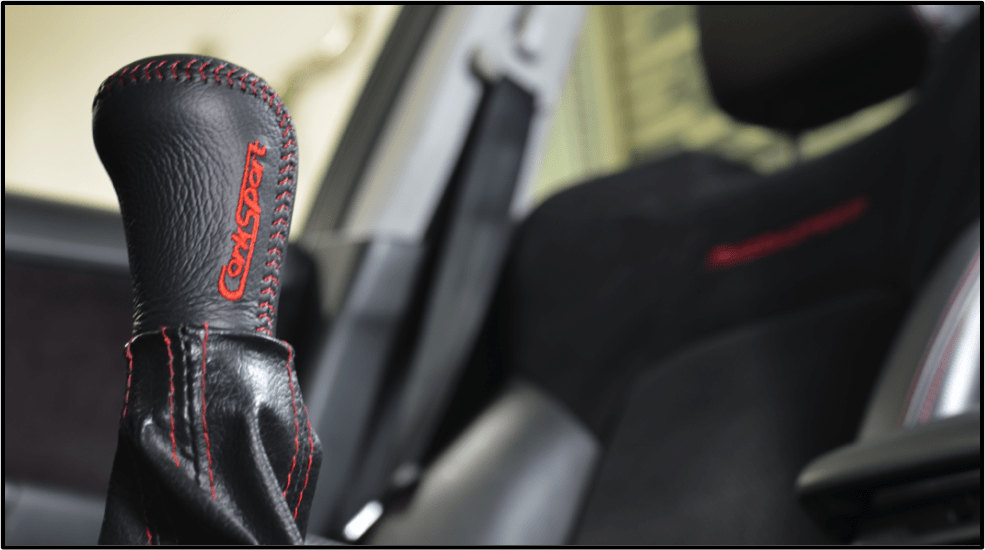
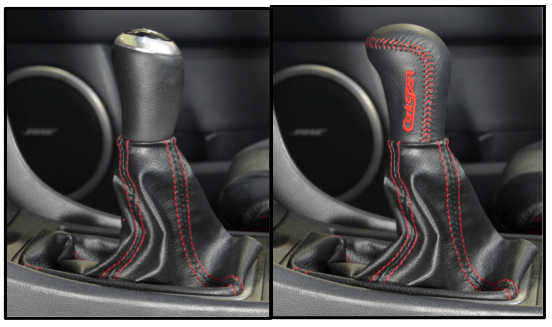
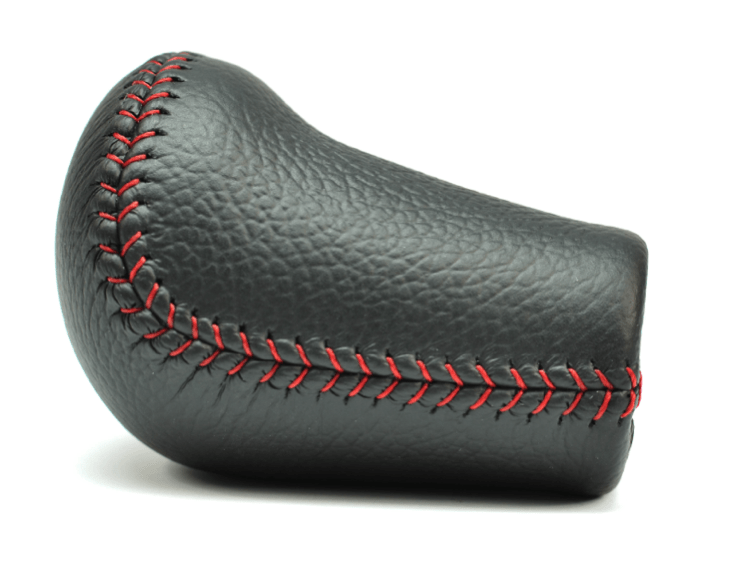
Weighing in at a respectable 320 grams, the CorkSport leather shift knob will help smooth your gear changes and customize the interior of your Mazda while doing so. With an ergonomic design and large top surface, the CorkSport leather shift knob is comfortable to use for any grip position. Check out the difference between the OEM shift knob and the CorkSport leather shift knob.
Manufactured from Delrin plastic, then hand-wrapped and stitched with high grade black leather, the CorkSport leather shift knob will stand up to daily driving and track use day-in and day-out. The baseball style stitches are tight and clean, leaving no loose edges to fray or annoy you; and the leather has a slight texture and plushness to it, so it feels great in your hand.
Don’t wait! Get your leather shift knob today before they’re gone!
-Barett, CS Engineering
The CorkSport Leather Shift Knob for Mazdas February 6th, 2015Derrick Ambrose
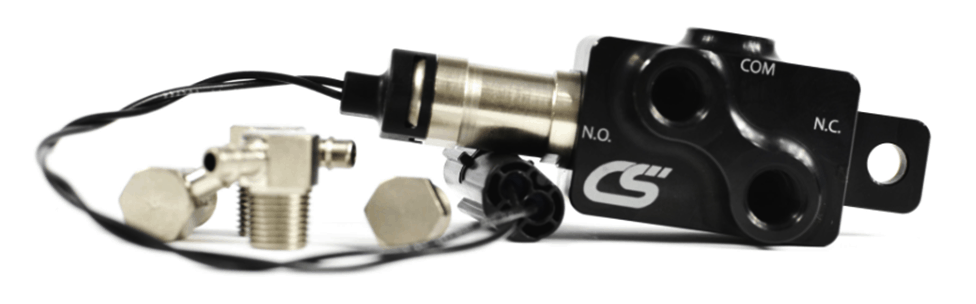
Fighting boost spikes with the Mazdaspeed K04 Turbo or maybe boost creep with an internally gated GT3076R? Or have you gone all out with an externally gated setup? Whatever the reason, you have probably realized that the OEM boost control solenoid is not up to par and desperately needs something that is reliable and tunable.
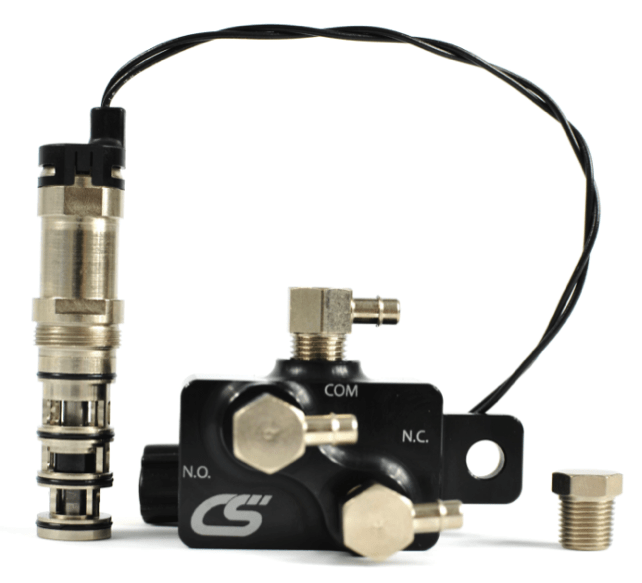
The CorkSport EBCS utilizes the latest technology in solenoid-controlled air valves, as well as using a light weight, low friction, and balanced valve design. The CorkSport EBCS will handle pressures from vacuum to 120psi with an operating frequency of 0 – 1000Hz and response time of 700µs.
So what does this actually mean to you?
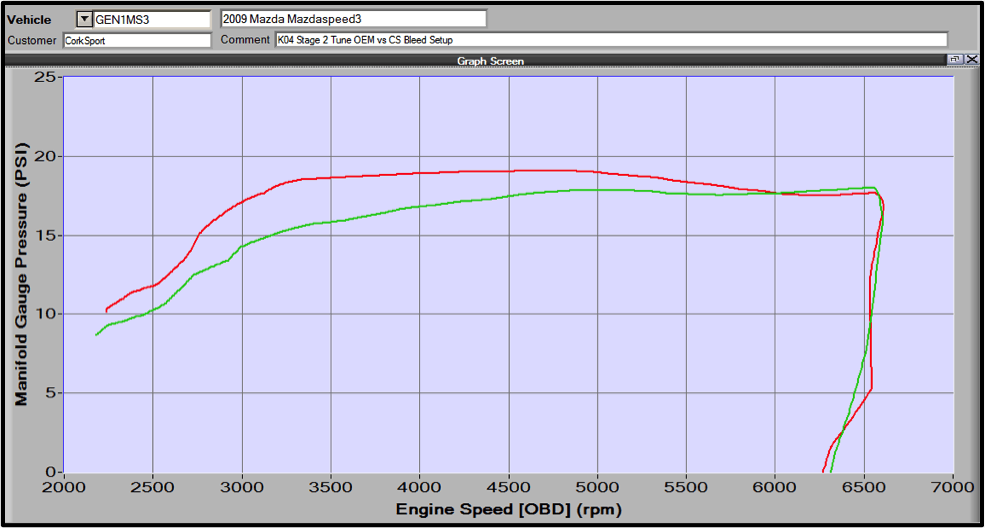
You can build boost faster, reduce or eliminate boost spikes, and hold boost more accurately throughout the RPM range. Don’t believe me? Then check out the graph below comparing the OEM EBCS to the CorkSport EBCS both in bleed setup.
You can see a noticeable difference between the two graphs. Boost rises sooner, and there is no overshoot with the CorkSport EBCS. With the same Stage 2 tune, only changing the EBCS and adjusting the waste gate duty cycles, we saw an increase of 18 ft-lb of torque at peak due to the more boost at a lower RPM.
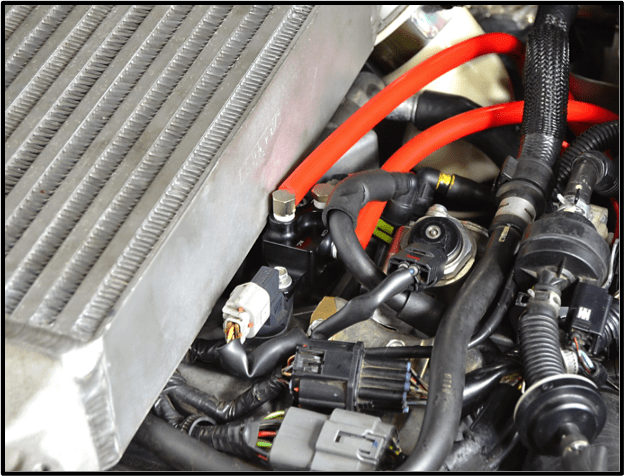
Not only does the CorkSport EBCS work great, but it also fits great! Designed with ease of installation in mind, the EBCS can be located in the OEM location, or on the valve cover for turbochargers without the OEM tab. This goes for both TMIC and FMIC setups. There is also no wire cutting or soldering needed! Simply plug the electrical connector into the wiring harness and you are ready to go!
Whether you are just stepping into the Mazdaspeed world or are the horsepower king at the local dyno, there is a place under your hood for the CorkSport EBCS. This will benefit you from K04 turbocharger to an externally gated GT3582R, and there are two ways to look at the CorkSport EBCS. First, it’s a potential power adder due to its far superior response time, efficiency, and accuracy; or second, it’s a safety device for the exact same reasons. Now there is one catch…correct use of the CorkSport EBCS will require adjustments of the waste gate duty cycles. We recommend you contact a professional tuner to setup your new CorkSport EBCS.
Take control of your boost with the CorkSport Mazdaspeed Electronic Boost Control Solenoid! For more technical information check out our white paper write-up of the EBCS.
-Barett, CS Engineering
The New CorkSport Mazdaspeed Electronic Boost Control Solenoid (EBCS) May 28th, 2024Derrick Ambrose
The Mazdaspeed platform is a pretty well-supported car in the engine performance and suspension market, but it seems to be lacking in some of the markets that truly allow you, as the driver, to connect to the car. This is especially true for the GenWon owners. Well, CorkSport has decided to help the forgotten GenWon owners become more intimately connected to their Speed3. So what are the components of a car that the driver is most intimate with? I would have to say the pedals, seat, steering wheel, and, of course, the shifter.
So which of those did we release? It’s not pedals. (Autozone has that covered.) Unfortunately, it’s not a seat, but that would be awesome. It’s not a steering wheel…yet. (Oops. Did I say that out loud?) I’m happy to say it’s a short shifter, and not the kind that goes under the hood. Sure, there are a few options out there, but they leave a lot on the table and the price seems ridiculous.
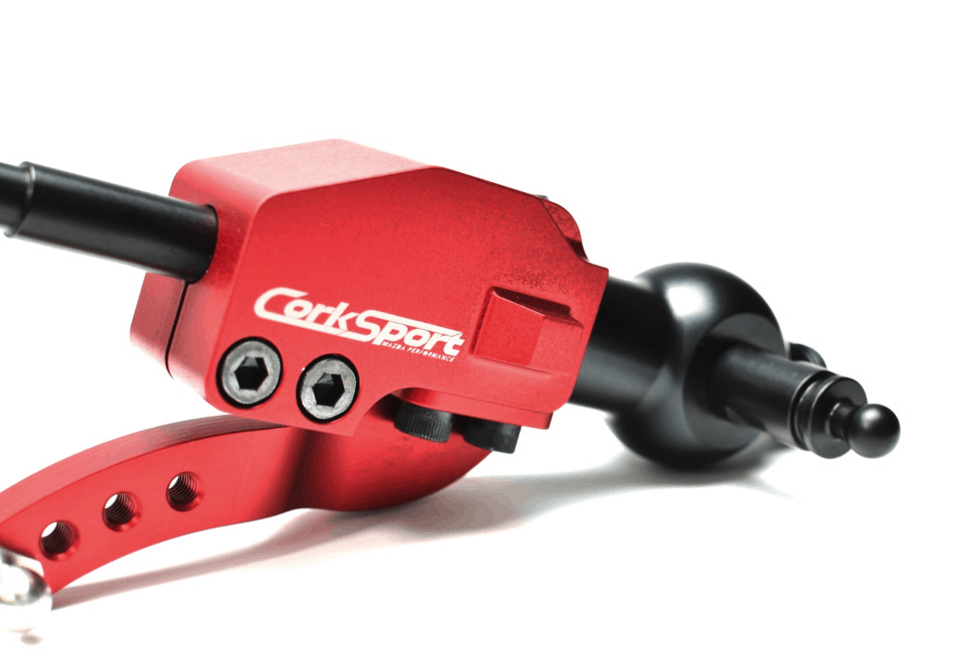
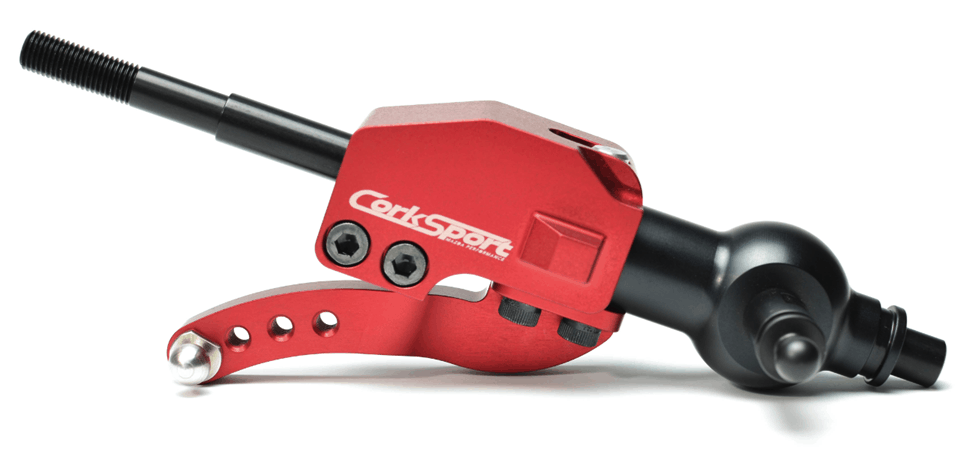
Manufactured from high-grade 6061-T6 aluminum, this precision machined double adjustable short shifter is sure to give you that intimate connection and control with your Speed3. Plus, it’s 100% designed and manufactured right here in the Pacific NW, USA.
So what sets the CorkSport Short Shifter apart from the competition? This short shifter is double-adjustable, but not in the way the competition defines it. First, there are four throw positions ranging from OEM throw distance to the 35% shorter throw distance. Second, the shift knob height is adjustable from 11.75 to 9.5 inches tall with the OEM height being 11.125 inches. Lastly, just look at it: It’s gorgeous. It’s a shame it gets hidden under the shift boot.
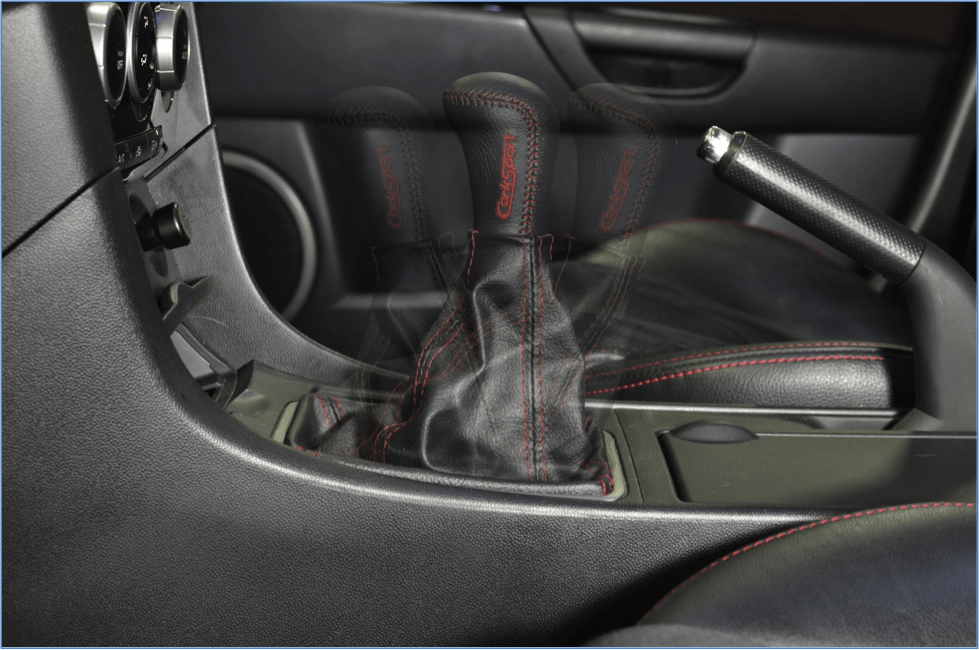
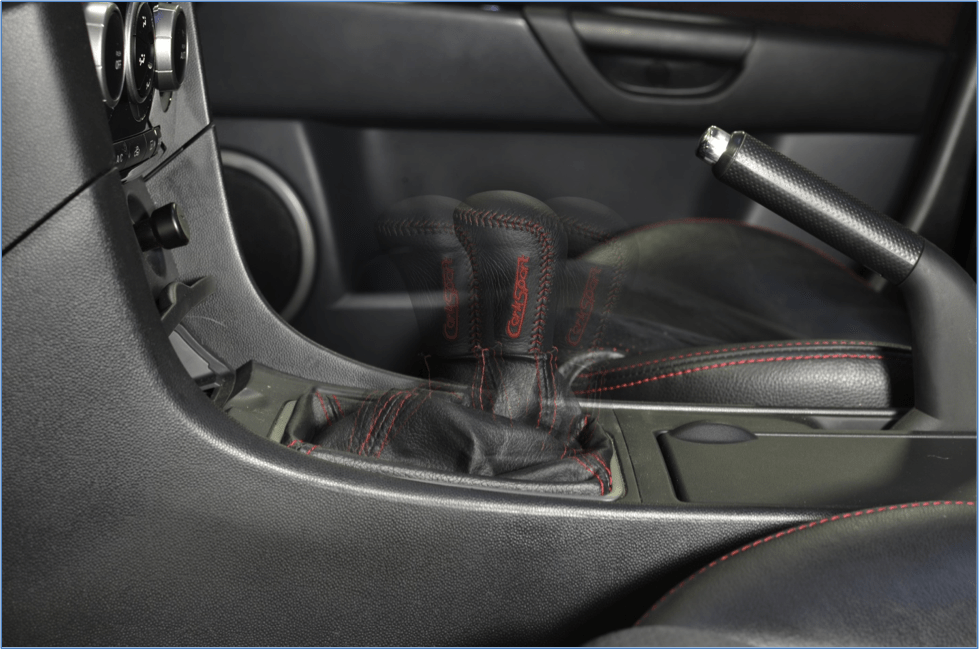
Take a look at the comparison images below:
This image shows the forward, neutral, and back positions of the OEM shifter.
This image shows the forward, neutral, and back positions of the CorkSport Short Shifter in its shortest height and shortest throws position.
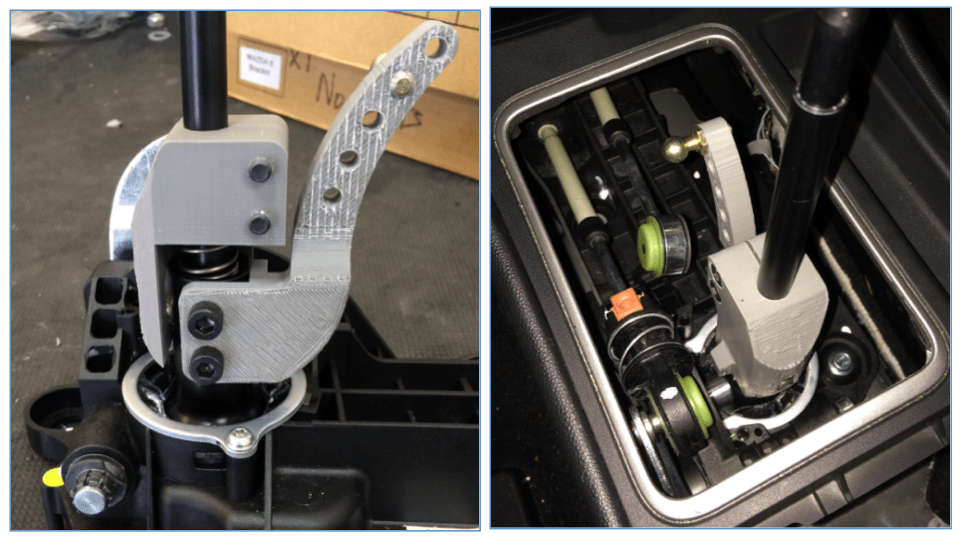
Of course, a product like this doesn’t come to life overnight. There were many hours of design, testing, and revision done to verify that the product you receive is the best it can be. Below are a couple images of 3D-printed prototype we made on our 3D printer to help speed up the R&D.
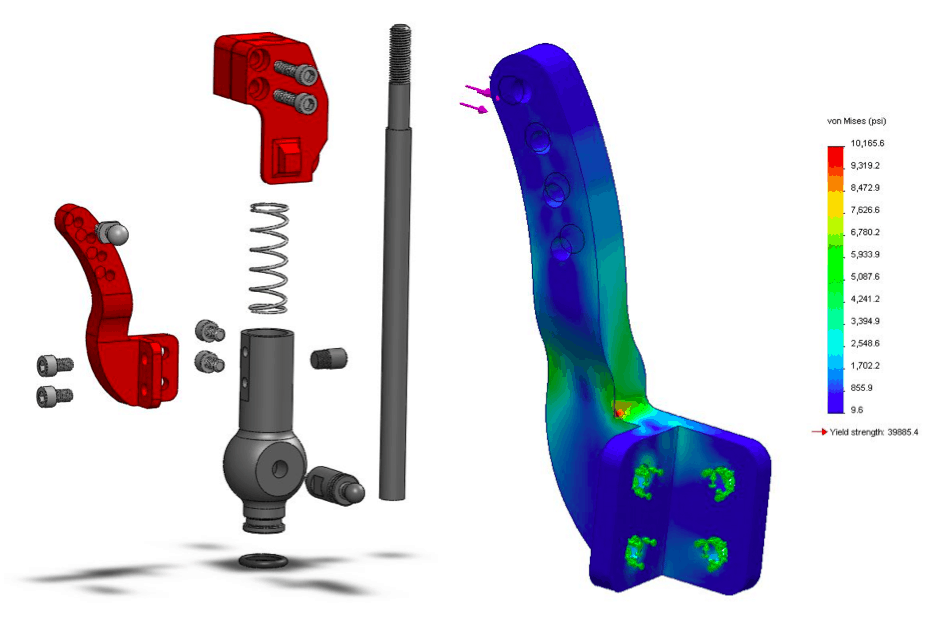
In addition to the prototype testing, we also perform FEA (Finite Element Analysis) on all applicable components to verify they’re strong enough to last for many, many years. Below is a complete CAD model and the FEA for the throw adjustment arm with 50 lbf applied to the shortest throw position. This is the worst case scenario, so if it doesn’t fail here it won’t fail in the other positions.
With the 50 lbf applied to the arm, the maximum stress was ~10k psi which is great news. This component alone is 4 times stronger than it needs to be if you were able to apply 50 lbf to the arm.
I have personally been using this shifter in my 2009 Speed3 for a month now and have nothing but great things to say. Don’t take it from me, though. Here is a quote from a beta tester:
I’m taking a spirited drive today to get a better feel for it. So far I’m enthusiastic about the (extreme) difference. When shifting with the OEM shifter the throw was so long that I spent a lot of effort synchronizing the clutch with the motion of shifting—essentially slipping the clutch while completing the motion of going into gear. With your short throw shifter the entire motion has changed dramatically and all I have to concentrate on is the clutch, and that’s been reduced by ~50%. I just throw it into gear and pop the clutch. It’s so stiff anyway and really likes to engage/disengage near the end when releasing pressure on the pedal that the motion becomes much more fluid. The shifter motion has gotten much tighter and requires (what feels like) more pressure to move between gears, but the motion itself has been reduced so much that it creates a sense of precision and removes (what felt like) sloppiness when using the OEM shifter. I’m sure that adjusting the height & throw from such an extreme position would reduce what I would describe as the rigidity of the shifts, although I intend to continue using it in the position we installed it.
My 2 cents so far. Overall I’d highly recommend.
Hope all is well,
Michael
So what are you waiting for? Take the leap, you won’t be disappointed!
-Barett, CS Engineering
The New CorkSport Adjustable Short Shifter April 8th, 2020Derrick Ambrose